

How to Complete a Mega Backdoor Roth

Skloff Financial Group Question of the Month – June 1, 2026
By Aaron Skloff, AIF, CFA, MBA
Q: We read ‘How to Complete a Backdoor Roth IRA’. What other strategies can we use to build our Roth savings?
The Problem — Building Tax-Free Savings
Roth Individual Retirement Accounts (IRAs) are highly desirable for retirement savers because they allow for tax-free growth, tax-free withdrawals, and are exempt from required minimum distributions (RMDs). Fortunately, the Backdoor Roth IRA helps build tax-free savings. Unfortunately, annual contributions are capped at $7,500 for those under age 50, and $8,600 for those age 50 and over.
The Solution — Mega Backdoor Roth
A Mega Backdoor Roth is an advanced 401(k) strategy that lets high-income earners contribute substantially more to a Roth account than standard limits allow. Internal Revenue Code (IRC) Section 402(g) sets annual limits for standard employee contributions (deferrals) to 401(k)s per year: $24,500 for participants under the age of 50, $32,500 for ages 50–59 or 64+, or $35,750 for ages 60–63. IRC Section 415(c) sets annual contribution limits for combined employee and employer (i.e., matches and profit sharing) contributions to 401(k)s per year: $72,000 for participants under the age of 50, $80,000 for ages 50–59 or 64+, or $83,250 for ages 60–63.
Are You Interested in Learning More?

In addition to your standard pre-tax (Traditional) or after-tax (Roth) 401(k) employee contributions and employer matches and/or profit-sharing contributions, you can make after-tax contributions to maximize your 415(c) annual limit. The 415(c) limit is almost triple the 402(g) limit for those under the age of 50. The problem: while the growth on Roth contributions is tax-free upon withdrawal, the growth on after-tax contributions is subject to income taxes upon withdrawal.
The Mega Backdoor Roth with Automatic In-Plan Conversions. By utilizing a Mega Backdoor Roth with Automatic In-Plan Conversions, you solve this problem. If you immediately convert after-tax contributions to Roth through an in-plan conversion (or to a Roth IRA as an in-service withdrawal), the growth on those after-tax contributions becomes tax-free upon withdrawal. If you delay the conversion, the growth on your contributions will be subject to income taxes at the time of the conversion. Therefore, if you establish an automatic in-plan conversion to Roth with each after-tax contribution before any growth occurs, you can effectively replicate the benefits of a Roth contribution using after-tax dollars to achieve tax-free growth and tax-free withdrawals.
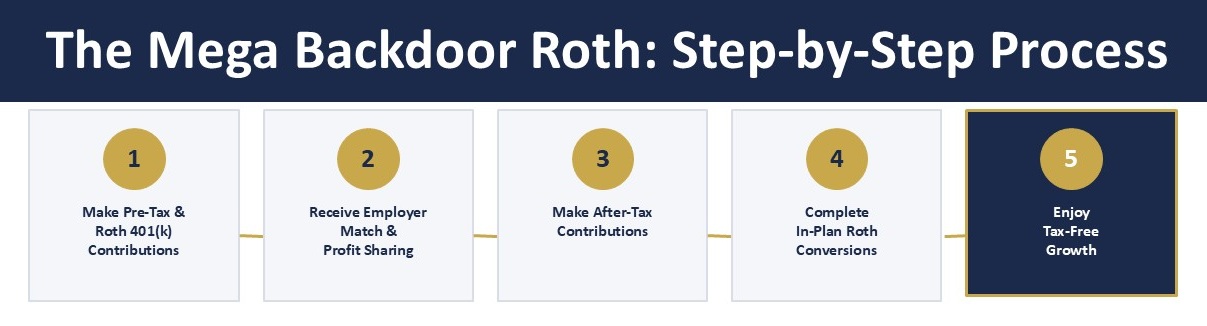
The Mega Backdoor Roth: Step-by-Step Process
Step 1 – Make Pre-Tax and/or Roth 401(k) Contributions. Contribute the optimal amount to maximize employer matches.
Step 2 – Receive Employer Matches and Profit Sharing. Employer contributions count towards the 415(c) limit.
Step 3 – Make After-Tax Contributions. Contribute after-tax dollars to fill the remaining 415(c) gap.
Step 4 – Complete In-Plan Roth Conversions. Auto-convert upon each contribution to preserve tax-free growth.
Step 5 – Enjoy Tax-Free Growth and Tax-Free Withdrawals. Gains and withdrawals are tax-free for you and your heirs.
Click to Enlarge
Have Your Cake and Eat It Too. You can complete a Backdoor Roth IRA and Mega Backdoor Roth in the same year.
Not All 401(k) Plans Allow Mega Backdoor Roth or Automatic In-Plan Conversions. While the IRC allows for the Mega Backdoor Roth, some employers are not aware of or do not permit this strategy. Furthermore, not all plans offer automatic in-plan conversions.
Action Step — Complete a Mega Backdoor Roth
Work closely with your Registered Investment Adviser to evaluate your Mega Backdoor Roth opportunities.
Aaron Skloff, Accredited Investment Fiduciary (AIF), Chartered Financial Analyst (CFA), Master of Business Administration (MBA) is CEO of Skloff Financial Group, a Registered Investment Advisory firm specializing in financial planning, investment management and benefits for small to middle sized companies. He can be contacted at www.skloff.com or 908-464-3060.

Have Your 401(k), 403(b), 457(b) Account Professionally Managed
Frequently Asked Questions
Q; What is a Mega Backdoor Roth?
A Mega Backdoor Roth is an advanced 401(k) strategy that allows high-income earners to move substantially more money into a Roth account than the standard annual Roth or 401(k) deferral limits would otherwise permit. It works by taking advantage of the much higher combined contribution limit that applies to a 401(k) plan under IRC Section 415(c), which covers employee deferrals, employer matches and profit sharing, and after-tax contributions combined. Because the 415(c) limit is nearly three times the standard employee deferral limit for those under 50, it creates room for large additional after-tax contributions that can ultimately be converted to Roth status.
Q: How is a Mega Backdoor Roth different from a regular Backdoor Roth IRA?
A standard Backdoor Roth IRA is a way to fund a Roth IRA indirectly when income limits would otherwise prevent a direct contribution, but it is capped at the relatively modest annual IRA contribution limits of $7,500 for savers under age 50 and $8,600 for those age 50 and over. A Mega Backdoor Roth operates inside an employer 401(k) plan rather than an IRA, and it takes advantage of the much larger IRC Section 415(c) combined contribution limit, allowing savers to shelter tens of thousands of dollars more per year in a Roth-style account. The two strategies are not mutually exclusive, and a saver can use both a Backdoor Roth IRA and a Mega Backdoor Roth in the same year.
Q: What 401(k) contribution limits apply for 2026?
Two separate IRS limits govern how much can move through a Mega Backdoor Roth in 2026. IRC Section 402(g) caps standard employee deferrals to a 401(k) at $24,500 for participants under age 50, $32,500 for those age 50–59 or 64 and older, and $35,750 for those age 60–63. IRC Section 415(c) caps the combined total of employee contributions, employer matches, profit sharing, and after-tax contributions at $72,000 for participants under age 50, $80,000 for those age 50–59 or 64 and older, and $83,250 for those age 60–63. The gap between these two limits is what makes room for the large after-tax contributions used in a Mega Backdoor Roth.
Q: Where do the extra contributions in a Mega Backdoor Roth come from?
After a participant has made their standard pre-tax or Roth employee contributions and received any employer match or profit-sharing contribution, there is typically still room remaining under the higher 415(c) combined limit. A Mega Backdoor Roth strategy fills that remaining space with additional after-tax contributions, which are distinct from standard Roth contributions and are taxed differently. These after-tax dollars are the vehicle that ultimately gets converted to Roth status as part of the strategy.
Q: What is the problem with simply making after-tax 401(k) contributions and leaving them alone?
While Roth contributions grow completely tax-free and are withdrawn tax-free, ordinary after-tax 401(k) contributions do not receive the same treatment. The original contribution amount is not taxed again since it was already taxed dollars, but any investment growth on those after-tax contributions is subject to income tax when eventually withdrawn. Left unconverted, after-tax contributions lose much of the tax advantage that makes Roth savings so appealing for long-term retirement growth.
Q: How does an in-plan Roth conversion solve this problem?
The solution is to convert the after-tax contributions to Roth status inside the plan, either through an in-plan conversion or by rolling them out as an in-service withdrawal into a Roth IRA, and to do so as quickly as possible after each contribution. If the conversion happens before any meaningful investment growth has occurred, there is little or no taxable gain to convert, and all future growth on those dollars then qualifies for tax-free treatment. Some 401(k) plans go a step further and offer an automatic in-plan conversion feature that converts each after-tax contribution to Roth immediately and automatically, which removes the need to time or track conversions manually and helps ensure the growth stays tax-free.
Q: What are the steps to complete a Mega Backdoor Roth?
The process generally follows five steps. First, make standard pre-tax and/or Roth 401(k) contributions, prioritizing the amount needed to capture any available employer match. Second, receive employer matching and profit-sharing contributions, which count toward the overall 415(c) limit. Third, make after-tax contributions to fill the remaining gap between what has already been contributed and the 415(c) ceiling. Fourth, complete an in-plan Roth conversion on each after-tax contribution, ideally automatically, so the dollars convert before meaningful growth occurs. Fifth, enjoy the resulting tax-free growth and tax-free withdrawals on those converted funds, a benefit that can extend to heirs as well.
Q: Can everyone with a 401(k) use a Mega Backdoor Roth?
No. Even though the IRS Code permits the strategy, not every employer plan is designed to support it. Some plan sponsors are simply unaware of the strategy or choose not to offer it, and even among plans that allow after-tax contributions, not all of them offer the in-plan or automatic conversion feature that is necessary to preserve the tax-free growth benefit. Whether the strategy is available depends entirely on the specific plan design at a given employer, so it is important to confirm both after-tax contribution and in-plan conversion availability before attempting to use it.
Q: Can I do a Backdoor Roth IRA and a Mega Backdoor Roth in the same year?
Yes. These two strategies are complementary rather than competing, since one works through an IRA and the other works through an employer-sponsored 401(k) plan. A saver whose 401(k) plan supports after-tax contributions and in-plan conversions can pursue both strategies in the same tax year, potentially directing significantly more money into Roth accounts than either strategy could accomplish on its own.
Q: What should I do next if I’m interested in a Mega Backdoor Roth?
Because plan availability and conversion features vary widely, the recommended next step is to work closely with a Registered Investment Adviser to review your specific 401(k) plan documents, confirm whether after-tax contributions and in-plan Roth conversions are offered, and evaluate whether a Mega Backdoor Roth strategy fits your broader retirement and tax planning picture. A qualified adviser can also help coordinate the strategy with other tools, such as a Backdoor Roth IRA, to maximize tax-free retirement savings within IRS rules.