

How to Get the Most Out of Trump Accounts – Part 1
Money Matters – Skloff Financial Group Question of the Month – October 1, 2026
By Aaron Skloff, AIF, CFA, MBA
The Problem — Understanding Trump Accounts
Although Congress does a reasonable job explaining Trump Accounts in CRS Product Number R48910, reasonable is insufficient when it comes to financial planning. Understanding Trump Accounts and how to get the most out of them can be confusing.
The Solution — Understanding Trump Accounts and How to Get the Most Out of Them
Section 530A Accounts, known as Trump Accounts, allow you to start saving and investing for your child’s retirement as early as the day they are born. Authorized under Internal Revenue Code (IRC) Section 530A, these tax-advantaged accounts combine government seed funding with private contributions to establish a tax-sheltered investment foundation for children from birth through age 17.
Until age 18, beneficiaries cannot take withdrawals, whether those contributions are made by themselves or by others. Any income earned within the account (e.g., investment earnings) will not be taxed until withdrawal, like other traditional IRAs. During the growth period, savings in Trump Accounts must be invested in a diversified index fund of U.S. stocks and must minimize fees and expenses. Starting on January 1 of the year the child turns 18, contributions, investments and withdrawals follow the same rules as other traditional IRAs.
Are You Interested in Learning More?
Key Features and Rules of Section 530A Accounts
1. Government Seed Contribution: Every eligible child born receives a one-time pre-tax government contribution of $1,000 placed into their Section 530A account in Year 1.
2. Private Contribution Limits: Parents, family and friends can make after-tax annual contributions (in cash or qualified stock contributions) up to $5,000 per child through age 17. Employer contributions up to $2,500 per year tax-free (to employee) per employee (across all children’s accounts) count towards the per child limit. Qualified stock contributions (and associated transferred gains) must remain in the Section 530A account for a minimum 5-year holding period before penalty-free distributions or conversions of those specific contributed assets can occur.
3. Tax-Deferred Growth: Investments grow tax-deferred until withdrawn.
4. Pro-Rata Taxation Structure: Withdrawals and conversions consist of both non-taxable cost basis (after-tax parent contributions) and taxable earnings/seed money, calculated on a pro-rata basis.
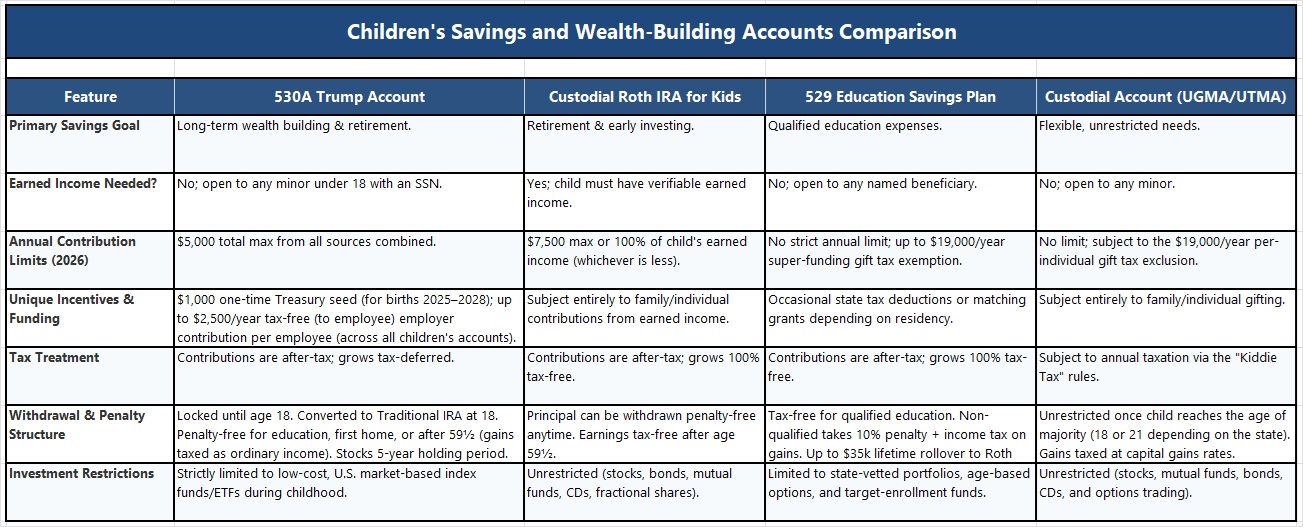
Children’s Savings and Wealth-Building Accounts Comparison
When comparing savings and wealth-building vehicles for your children, consider: the primary savings goal, whether earned in come is required, whether there are contribution limits or incentives, the tax treatment, withdrawal rules, and investment restrictions.
Although Trump Accounts offer a $1,000 pre-tax government contribution, planning is required to avoid unnecessary taxes on withdrawals.
While Custodial Roth IRAs for Kids are one of the most attractive tax-free retirement vehicles, they require the child to have earned income.
Although 529 accounts offer tax-free withdrawals for qualified education expenses, non-qualified withdrawals are subject to penalties and taxes.
While Custodial accounts are very flexible, they are subject to the Kiddie Tax.
Click to Enlarge
Action Step – Get the Most Out of Trump Accounts
Work closely with your Registered Investment Adviser (RIA) to optimize your contributions and withdrawals from Trump Accounts in the context of your financial plan.
Aaron Skloff, Accredited Investment Fiduciary (AIF), Chartered Financial Analyst (CFA), Master of Business Administration (MBA) is CEO of Skloff Financial Group, a Registered Investment Advisory firm specializing in financial planning, investment management and benefits for small to middle sized companies. He can be contacted at www.skloff.com or 908-464-3060.

Are You Interested in Learning More?
Frequently Asked Questions
Q: What is a Section 530A Trump Account, and when can one be opened?
A Section 530A Trump Account is a tax-advantaged account authorized under Internal Revenue Code Section 530A designed to kickstart long-term savings and retirement for children. A Trump Account can be established as early as the day a child is born and maintained through age 17. These accounts combine government seed funding with private contributions, establishing a tax-sheltered investment foundation during a child’s earliest years.
Q: How are earnings taxed and growth managed inside a Trump Account?
During the child’s youth, investment growth within a Trump Account is tax-deferred, meaning any interest, dividends, or capital gains are not taxed until distributed—similar to a Traditional IRA. To maximize growth and protect young investors, savings during the growth phase (ages 0 to 17) are required to be invested in low-fee, diversified index funds of U.S. stocks.
Q: Can withdrawals be made before the child turns 18?
No, early withdrawals are strictly restricted prior to the beneficiary reaching adulthood. Until the child turns 18, beneficiaries and parents cannot make withdrawals from the account, regardless of whether the funds originated from government seed money or private contributions. This lock-in period ensures that the principal and compounding interest remain intact throughout the child’s entire upbringing.
Q: What happens to the Trump Account once the beneficiary turns 18?
Starting on January 1 of the calendar year the child turns 18, the Trump Account transitions into standard Individual Retirement Account (IRA) guidelines. From that point forward, contribution limits, investment options, distribution rules, and penalties follow the exact same regulatory frameworks that apply to Traditional IRAs.
Q: Who can contribute to a Trump Account, and are there contribution limits?
Trump Accounts accept contributions from multiple sources, including federal seed contributions, parents, family members, and third parties up to annual statutory caps established by federal tax law. Because these accounts are created for long-term growth, lifetime and annual private contribution limits apply to prevent high-net-worth tax shelter abuse while encouraging broad participation across income brackets.
Q: How do Trump Accounts differ from traditional 529 College Savings Plans?
While both 529 plans and Trump Accounts offer tax-advantaged growth for children, their ultimate purpose and withdrawal rules differ significantly. 529 plans are primary vehicles for higher education expenses, offering tax-free withdrawals for qualified educational costs. In contrast, Trump Accounts operate as early-start retirement vehicles subject to Traditional IRA rules once the minor reaches age 18, meaning non-qualified early withdrawals for non-retirement purposes may incur income tax and early withdrawal penalties.