Roth IRA Conversions 2015
Money Matters – Skloff Financial Group Question of the Month – October 1, 2015
By Aaron Skloff, AIF, CFA, MBA
Q: Through diligent savings we have accumulated large Individual Retirement Accounts (IRAs). Due to recent market volatility we are concerned about converting our Traditional IRA to a Roth IRA. What are the implications of converting them into Roth IRAs?
A: The Problem — Taxes on Withdrawals from Pre-Tax IRAs
Your diligence has paid off, but could present large tax obligations in the future. The combination of pre-tax savings and the sheltering of taxation of capital gains, dividends and interest on those savings all contribute to large pre-tax IRAs. One of the problems with pre-tax (versus post-tax) savings is the tax obligations on withdrawals. If you take withdrawals before age 59 1/2 you are subject to a 10% penalty and income taxes. If you take withdrawals after 59 ½ you avoid the10% penalty, but you are still subject to income taxes. With few exceptions, you must begin taking withdrawals in the form of Required Minimum Distributions (RMDs) by April 1 of the year after you reach age 70 ½. Unfortunately, the RMD percentage increases each year.
Fair or unfair as it may be — the U.S. has a graduated income tax. The graduated income tax system assesses higher tax rates on higher income levels — the higher your income, the higher your tax bracket. Take too large of a withdrawal, even if it is an RMD, and you could be bumped up to a higher income tax bracket (marginal income tax rate).
Are You Interested in Learning More?
The Solution — Roth IRA Conversions
If you convert pre-tax Traditional IRA savings to Roth IRA savings you gain two tremendous benefits. The first benefit is withdrawals from Roth IRAs are exempt (free) from income taxes. This can have a positive domino effect, avoiding or reducing: capital gains and dividend taxes, net investment income taxes and itemized deductions and personal exemptions phaseouts (PEP). The second advantage is the avoidance of RMDs. Since Roth IRAs are not subject to RMDs, you can control when you make withdrawals or avoid them entirely. By avoiding or delaying withdrawals from your Roth IRAs you can further preserve your wealth or create a larger estate. Note: your spouse can inherit your Roth IRA and continue avoiding RMDs, while non-spouses are subject to tax free RMDs. By shrinking your pre-tax IRA savings through Roth IRA conversions you can avoid unnecessary taxes on those withdrawals.
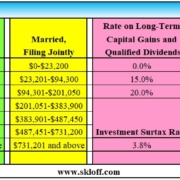
Timing Roth IRA Conversions. When you convert pre-tax IRA savings to tax free Roth IRA savings you could be subject to income taxes at the time of the conversion. This is where the graduated income tax could work to your advantage. The top marginal income tax rate is 39.6%. But, the marginal income tax rate is 15% on up to $74,900 of income in 2015 for married couples filing jointly. You are exempt from taxes on capital gains and qualified dividends on the same income and filing status. Translation: if your income falls below approximately $74,900 converting now can save you from higher income and investment taxes in the future. Even if your income exceeds $74,900 converting now can prevent you from being bumped up to a higher income and investment tax bracket in the future. So, the timing of your conversion is critical to optimizing your current and future taxes. The benefits of the conversion assume you pay the tax obligations from assets outside of the IRAs.
Market Volatility Presents Conversion Opportunity with a Pre-Tax Traditional IRA. Let’s look at an example of a Traditional IRA that is funded with 100% pre-tax savings that was worth $150,000 before recent market volatility, but is now worth $100,000. Applying a 25% income rate to the full conversion prior to the recent market volatility would have resulted in a $37,500 tax bill, but a more palatable $25,000 tax bill after the recent market volatility. A temporary decline can provide a window of opportunity to take advantage of a less costly conversion. If they convert the full amount in one year they could create a negative domino effect, creating or increasing their: tax bracket, capital gains and dividend taxes, net investment income taxes and itemized deductions and personal exemptions phaseouts (PEP). If they complete partial Roth IRA conversions, say $25,000 over four years, they could avoid the negative domino effect – reaping big tax savings. Assuming a flat financial market and 15% income tax rate, they would be subject to $15,000 ($3,750 per year for four years) in taxes.
Market Volatility Presents Conversion Opportunity with a Post-Tax Traditional IRA. The financial media often overlooks one of the most important ways to mitigate the tax bill of a conversion. The secret is in IRS Form 8606. Each time you make post-tax Traditional IRA contributions the IRS requires you to file 8606 so you and they know what your cost basis is in your Traditional IRA. Form 8606 also allows you to reduce or eliminate the taxes on RMDs and/or Traditional IRA conversions to Roth IRAs. Since you already paid taxes on the basis, you are only taxed on the gain. Let’s look at an example of a Traditional IRA that is funded with 90% post-tax savings that was worth $150,000 before recent market volatility, but is now worth $100,000. Applying a 15% income rate to the full conversion of $150,000 prior to the recent market volatility would have resulted in a $2,250 tax bill, since only 10% of the conversion is subject to income taxes. But, a full conversion of $100,000 after the market volatility would have resulted in a $1,500 tax bill, since only 10% of the conversion is subject to income taxes.
Action Steps
Work closely with your Registered Investment Adviser (RIA) and tax professional in evaluating or completing a full or partial Roth IRA conversion. Keep good tax records leading up to, during and after the conversions. Utilize IRS Form 8606 to avoid any unnecessary taxes.
Aaron Skloff, Accredited Investment Fiduciary (AIF), Chartered Financial Analyst (CFA), Master of Business Administration (MBA) is CEO of Skloff Financial Group, a Registered Investment Advisory firm specializing in financial planning, investment management and benefits for small to middle sized companies. He can be contacted at www.skloff.com or 908-464-3060.