
Employee Incentive Stock Options – Use Them or Lose Them

Money Matters – Skloff Financial Group Question of the Month – September 1, 2021
Employee Incentive Stock Options – Use Them or Lose Them
By Aaron Skloff, AIF, CFA, MBA
Q: My employer has awarded me numerous stock options. When can I exercise them and what are the tax ramifications?
A: The Problem. Many employers award stock options to attract and retain employees. Unfortunately, many employees do not truly understand the different types of options they are awarded, their tax ramifications and how their terms can change.
The Solution – Understanding Employee Incentive Stock Options. Employers can grant employee incentive stock option (ISOs) that give employees the right, but not the obligation, to purchase company stock at a certain price in the future. If utilized in the right manner, ISOs can benefit both the employers and employees. Key to utilizing them in the right manner is understanding their key characteristics, described below.
Are You Interested in Learning More?

Grant Agreement. This agreement defines the type, number, exercise price, expiration date and vesting schedule of your options.
Grant Date. This is the day you are issued (granted) the options.
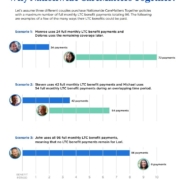
Exercise Price. The option’s exercise price (or strike price) is the price at which you can purchase company stock from the company. The exercise price is generally set above the stock price on the day the grant is given. If the exercise price is below the stock price, the option is considered ‘in the money’ or ‘above water’. For example, if the exercise price is $10 and the stock is trading at $12, the option is in the money. If the exercise price is above the stock price, the option is considered ‘out of the money’ or ‘underwater’. For example, if the exercise price is $10 and the stock is trading at $8, the option is out of the money. See the chart below.
Click to Enlarge

Vesting Schedule. Before you can exercise your options, they must vest. Vesting is when the right to buy shares from your employer begins.
Taxes. In general, you do not have to pay taxes on ISOs when they are exercised. You are subject to the long term caital gains rates of 0%, 15% or 20% (based on your taxable income) instead of the 37% maximum income tax rate (sorry I.R.S.) if:
- You sell the ISO shares more than two years after the options grant date and
- More than one year after you bought the stock shares by exercising your ISOs
Expiration Dates. Since options are often awarded at different times, they have different expiration dates. A very valuable option leading up to its expiration date is worthless the day after its expiration date. So, be diligent when exercising your options.
ISO Example. On June 1, 2019, you receive an ISO giving you the right to purchase 100 shares of ABC stock for $10 per share. You exercise your ISO on July 2, 2020, when the stock price is $12. Your cost basis per share becomes $10. On August 3, 2021, you sell your ABC stock for $30 a share. The date of sale is more than two years after the June 1, 2019, grant date and more than one year after the July 2, 2020, exercise date. By meeting both of the conditions outlined in the paragraph above, your $2,000 profit ($30 X 100 shares – $10 X 100 shares) is a long term capital gain, subject to the 0%, 15% or 20% capital gains tax rate instead of the 37% maximum income tax rate (sorry I.R.S.).
Often Overlooked. Many stock option plans have clear language defining your rights about exercising your options upon termination from the company. For example, upon termination (other than by reason of death or disability) you have up to 90 days from the date of termination to exercise all or any part of your options that were exercisable at the date of termination. Severance from a job can be an emotional time, when you may overlook a material part of your wealth – your employee stock options. So, understand your ‘options’ on your options.
Action Step – Understand Your Options
Work closely with a Registered Investment Adviser (RIA) to make the best financial decisions with your employee stock options.
Aaron Skloff, Accredited Investment Fiduciary (AIF), Chartered Financial Analyst (CFA), Master of Business Administration (MBA) is CEO of Skloff Financial Group, a Registered Investment Advisory firm specializing in financial planning, investment management and benefits for small to middle sized companies. He can be contacted at www.skloff.com or 908-464-3060.

Are You Interested in Learning More?