
How To (Legally) Avoid Taxes When Selling Your Home – Part 2
Money Matters – Skloff Financial Group Question of the Month – June 1, 2024
By Aaron Skloff, AIF, CFA, MBA
Q: We read ‘How To (Legally) Avoid Taxes When Selling Your Home’ Part 1. We are ready to sell our home and are worried about paying taxes on our gain. What are the key tax considerations we should consider?
The Problem – Paying Unnecessary Taxes When Selling Your Home
Selling your home can be an exciting and sometimes stressful time. It is easy to lose track of tax records, copies of contracts and copies of home improvement receipts. Thus, many people miscalculate the gain on the sale of their home. Simply subtracting your purchase price from your sales price to determine your gain is a common and costly mistake.
Are You Interested in Learning More?

The Solution – How To (Legally) Avoid Taxes When Selling Your Home
To avoid the costly mistake of paying unnecessary taxes, it is important to understand how the IRS calculates your gain. The calculation is straight forward: Selling Price – Selling Expenses = Amount Realized – Adjusted Basis = Gain or Loss. As is often the case, the devil is in the details. One of the most important details is Adjusted Basis. Let’s examine Adjusted Basis below.
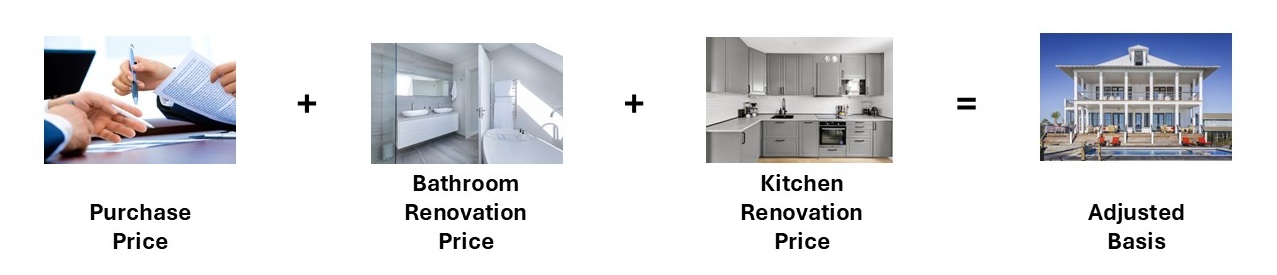
Adjusted Basis. These include the costs to purchase your home and improvements to your home. They include fees and closing costs, such as: legal fees, title search, recording fees and owner’s title insurance. They include costs owed by the seller that you paid, such as: real estate taxes owed up to the sale date, bank interest owed by the seller and sales commissions. They also include improvements and repairs done as part of a larger project. Let’s examine Improvements below.
Improvements. The following are examples of each.
Additions. Include those made to your bedroom, bathroom, deck, garage, porch, or patio.
Exterior. Include storm windows or doors, new roof, new siding, or satellite dish.
Insulation. Includes attic, walls, floors, pipes, and duct work.
Interior. Includes built-in appliances, kitchen modernization, flooring, wall-to-wall carpeting, and fireplace.
Plumbing. Includes septic system, water heater, soft water system, and filtration system.
Systems. Include heating system, central air conditioning, furnace, duct work, central humidifier, central vacuum, air/water filtration,
wiring, security system and lawn sprinkler system.
See an example of Adjusted Basis based on Improvements in the infographic below.
Repairs Done as Part of a Larger Project. You can include repair-type work if it is done as part of an extensive remodeling or restoration job. For example, replacing broken windowpanes is a repair, but replacing the same window as part of a project of replacing all the windows in your home counts as an improvement. When evaluating a repair, compare the cost of an improvement to simply completing the repair. Often, a contractor’s service call fee and time per hour may justify an improvement over a repair. Plus, the new item may look better and be more energy efficient.
Examples of Improvements You Cannot Include in Your Basis. Repairs or maintenance that are necessary to keep your home in good condition but do not add value or prolong its life cannot be added to your basis, including painting the interior or exterior, fixing leaks, filling holes or cracks, or replacing broken hardware. Improvements with a life expectancy, when installed, of less than one year cannot be added to your basis.
Click to Enlarge
Action Steps
Keep good tax records, copies of contracts and copies of receipts. Work closely with your Registered Investment Adviser (RIA) to reduce your taxes, and grow and preserve your wealth.
Aaron Skloff, Accredited Investment Fiduciary (AIF), Chartered Financial Analyst (CFA), Master of Business Administration (MBA) is CEO of Skloff Financial Group, a Registered Investment Advisory firm specializing in financial planning, investment management and benefits for small to middle sized companies. He can be contacted at www.skloff.com or 908-464-3060.

Are You Interested in Learning More?