

Skloff Financial Group
  • Home
  • About
    • Advisor Biography
    • How We Are Different
    • The Company
    • The Process
  • Financial Planning
    • College Planning
    • Estate Planning
    • Retirement Planning
    • Tax Planning
  • Wealth Management
    • 401(k), 403(b), 457(b) Account Management
    • 401(k), 403(b), 457(b) Rollover to an IRA
    • Top Five 401(k) Mistakes
    • Investment Management
    • Trust Management
    • Amazon 401(k)
    • Broadcom 401(k)
    • Cisco 401(k)
    • Google 401(k)
    • Meta 401(k)
    • Micron 401(k)
    • Microsoft 401(k)
    • NVIDIA 401(k)
    • Oracle 401(k)
    • Palo Alto Networks 401(k)
    • Qualcomm 401(k)
    • Salesforce 401(k)
    • Uber 401(k)
    • Workday 401(k)
  • Insurance
    • Annuities
    • Disability Insurance
    • Life Insurance
    • Long Term Care Insurance
  • Group Benefits
    • 401(k) Plans
    • 403(b) Plans
    • 457(b) Plans
    • Insurance Plans
  • Blog
  • Contact
  • Click to open the search input field Click to open the search input field Search
  • Menu Menu

Jumbo Roth IRA

Money Matters – Skloff Financial Group Question of the Month – May 1, 2016

By Aaron Skloff, AIF, CFA, MBA

Q:  Because I earn $300,000 per year I am disqualified from contributing to a Roth IRA.  Are there other ways to accumulate Roth IRA savings?

The Problem – Higher Earners Disqualified from Contributing to Roth IRAs

Roth Individual Retirement Accounts (IRAs) are highly desirable to retirement savers because they allow for growth on a tax free basis, withdrawals on a tax free basis and are exempt from required minimum distributions (RMDs).  Unfortunately, the IRS imposes income limits on those looking to contribute to Roth IRAs.  In 2016, the income phase-outs limits are from $117,000 to $132,000 for single filers and $184,000 to $194,000 for those married and filing jointly.  Translation: if you earn more than $132,000 as a single filer or $194,000 as a joint filer you cannot contribute to a Roth IRA.

Have Your 401(k), 403(b), 457(b) Account Professionally Managed

The Solution – 401(k), 403(b) and 457(b) Roth Contributions

Regardless of your income, you can contribute to a Roth 401(k), 403(b) or 457(b) retirement plan if your employer offers a Roth option.

Your contributions are limited to the lesser of your income or $18,000 (if you are under the age of 50) or $24,000 (if you are 50 or over).

Regardless of your income, you can also contribute to your retirement plan on an after tax basis if your employer offers an after tax option (not available on 457(b) plans).  Your additional contributions are limited to the lesser of your income or $35,000.

The IRS imposes annual per plan limits on contributions.  The combination of Roth, after tax and employer contributions cannot exceed $53,000 (for those under the age of 50) or $59,000 (for those age 50 or over).  Note: employer contributions must be on a pre-tax basis.

Create a Jumbo Roth IRA with a Tax Free In-Service Withdrawal and Rollover

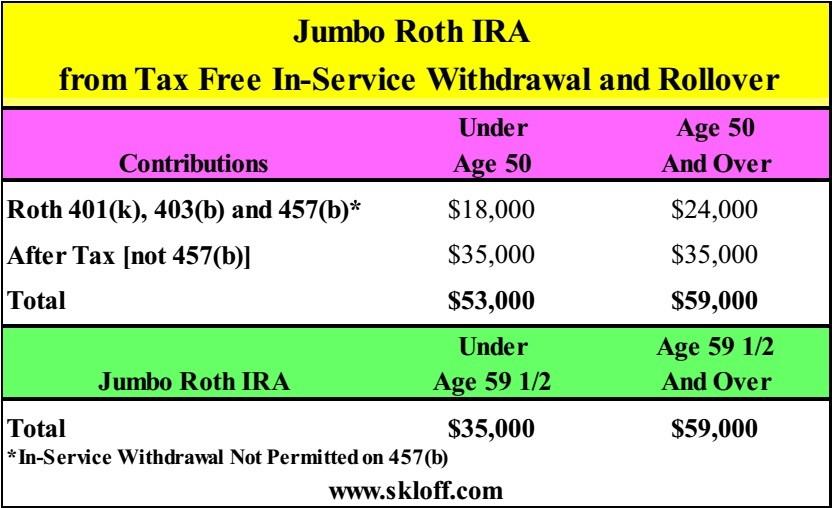
If you are under the age of 50 you can contribute a combined $53,000 to your employer plan ($18,000 Roth plus $35,000 after tax).  If you are 50 or over you can contribute $59,000 ($24,000 Roth plus $35,000 after tax).  You can then complete a tax free in-service withdrawal and rollover the after tax portion if under age 59 ½ to a Roth IRA or the entire amount if age 59 ½ and over, if your employer offers this option.

Fortunately, you can repeat this process every year. The following chart summarizes the process.

Click to EnlargeJumboRothIRA2016
Often Overlooked – Backdoor Roth IRA

In addition to the Jumbo Roth IRA described above you can also contribute another $5,500 (if you are under the age of 50) or $6,500 (if you are 50 or over) to a Backdoor Roth IRA.

Action Steps – Maximize Your Roth IRA Savings

Maximize your Roth IRA savings through Roth 401(k), 403(b), 457(b) contributions and after tax contributions, then complete a tax free in-service withdrawal and rollover.  Lastly, enjoy tax free withdrawals for the rest of your life or avoid withdrawals completely and leave a tax free Roth IRA for your heirs.

Aaron Skloff, Accredited Investment Fiduciary (AIF), Chartered Financial Analyst (CFA), Master of Business Administration (MBA) is CEO of Skloff Financial Group, a Registered Investment Advisory firm specializing in financial planning, investment management and benefits for small to middle sized companies. He can be contacted at www.skloff.com or 908-464-3060.

Adobe-PDF-Document-icon


Have Your 401(k), 403(b), 457(b) Account Professionally Managed

Tags: 401(k), 401(k) Contribution Limits, 403(b), 457(b), After Tax Contributions, Backdoor Roth IRA, catch-up 401(k), Highly Compensated Employee, In-Service Withdrawal, Jumbo IRA, Jumbo Rollover IRA, Jumbo Roth IRA, Key Employee, retirement plan, Retirement Planning, Roth 401(k), Roth 403(b), Roth 457(b), Roth IRA, Safe Harbor 401(k), SEP IRA, Special Section 457(b) Catch-up, Tax Free, Tax Free Income, Tax Planning, tax shelter, Taxes
https://skloff.com/wp-content/uploads/2016/12/Money-Roll-107509796.jpg 740 1100 Aaron Skloff, AIF, CFA, MBA https://skloff.com/wp-content/uploads/2025/10/sfg-8.png Aaron Skloff, AIF, CFA, MBA2016-05-01 12:00:382025-10-11 17:58:34Jumbo Roth IRA
You might also like
Bond Market Risks – Independent Press
Long Term Care Insurance Tax Benefits 2016 – Long Term Care University
Income Tax and Capital Gains Rates 2024
Employee Stock Options – Use Them or Lose Them
Brighthouse SmartCare Hybrid Life and Long Term Care Insurance Review – Long Term Care University
60% of People Say They Need Long Term Care Insurance Yet Only 17% Say They Have It
Pre-tax Versus Roth Employer Contributions to Retirement Accounts – Which Is Better? – Part 2
70% of Adults 65 And Over Will Need Long Term Care, 80% of Them Receive Care at Home from Unpaid Caregivers
Search Search
HTML Button Generator

Categories

  • – ARTICLES CATEGORIES
    • 401(k)
    • College Planning
    • Disability Insurance
    • Estate Planning
    • Financial Planning
    • Investing
    • IRA
    • Life Insurance
    • Long Term Care Insurance
    • Retirement Planning
    • Social Security
    • Taxes
  • – SLIDES CATEGORIES
    • 401(k)
    • College Planning
    • Estate Planning
    • Financial Planning
    • Investing
    • IRA
    • Life Insurance
    • Long Term Care Insurance
    • Retirement Planning
    • Social Security
    • Taxes
  • – VIDEOS CATEGORIES
    • 401(k)
    • College Planning
    • Disability Insurance
    • Estate Planning
    • Financial Planning
    • Investing
    • IRA
    • Life Insurance
    • Long Term Care Insurance
    • Retirement Planning
    • Social Security
    • Taxes

(c) Copyright 2026
Skloff Financial Group
7682 Santa Margherita Way
Naples, FL 34109
908-464-3060

Featured Content

Income Tax and Capital Gains Rates 2026
Retirement Plan Contribution Limits 2026
IRA Contribution and Income Limits 2026
Hybrid Life and Long Term Care Insurance

Information

CRS
Disclosures
Privacy Policy

HTML Button Generator
Link to: Long Term Care Insurance Approvals With Health Conditions – Long Term Care University Link to: Long Term Care Insurance Approvals With Health Conditions – Long Term Care University Long Term Care Insurance Approvals With Health Conditions – Long Term... Link to: Combination Life and Long Term Care Insurance Tax Benefits 2016 – Long Term Care University Link to: Combination Life and Long Term Care Insurance Tax Benefits 2016 – Long Term Care University Combination Life and Long Term Care Insurance Tax Benefits 2016 – Long...
Scroll to top Scroll to top Scroll to top