Skloff Financial Group
  • Home
  • About
    • Advisor Biography
    • How We Are Different
    • The Company
    • The Process
  • Financial Planning
    • College Planning
    • Estate Planning
    • Retirement Planning
    • Tax Planning
  • Wealth Management
    • 401(k), 403(b), 457(b) Account Management
    • 401(k), 403(b), 457(b) Rollover to an IRA
    • Top Five 401(k) Mistakes
    • Investment Management
    • Trust Management
    • Amazon 401(k)
    • Broadcom 401(k)
    • Cisco 401(k)
    • Google 401(k)
    • Meta 401(k)
    • Micron 401(k)
    • Microsoft 401(k)
    • NVIDIA 401(k)
    • Oracle 401(k)
    • Palo Alto Networks 401(k)
    • Qualcomm 401(k)
    • Salesforce 401(k)
    • Uber 401(k)
    • Workday 401(k)
  • Insurance
    • Annuities
    • Disability Insurance
    • Life Insurance
    • Long Term Care Insurance
  • Group Benefits
    • 401(k) Plans
    • 403(b) Plans
    • 457(b) Plans
    • Insurance Plans
  • Blog
  • Contact
  • Click to open the search input field Click to open the search input field Search
  • Menu Menu

Maximizing Contributions to Multiple Employer Retirement Plans 2019

Click to Enlarge

Maximizing Contributions to Multiple Employer Retirement Plans 

Then Completing In-Service Withdrawals and Rollovers to Jumbo IRAs

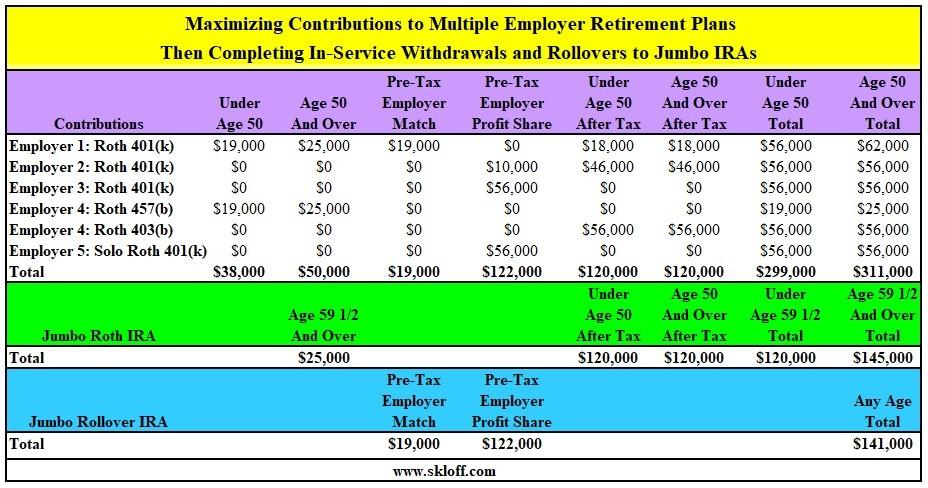
The IRS allows you to contribute to multiple employer retirement plans.  The IRS places an $19,000 annual limit ($25,000 if age 50 or over) on employee contributions (elective deferrals) cumulatively across 401(k)s and 403(b)s and the same limits cumulatively across 457(b)s. It also places a $56,000 limit ($62,000 if age 50 or over) on the combination of employee elective deferrals, employer contributions and employee after tax contributions .  As along as the employers are unrelated and not a controlled group (a parent-subsidiary employer that owns 80% of another employer or a brother-sister employer with five or fewer owners with a controlling interest in another employer), the limits are per employer.  You can have multiple employer retirement plans with $53,000 cumulative contribution limits and one with $59,000.

Create Jumbo IRAs with In-Service Withdrawals and Rollovers

After maximizing contributions, you can then complete a tax free in-service withdrawal and rollover of the after tax portion if under age 59 ½ to a Roth IRA , or Roth 401(k) and after tax contributions if age 59 ½ and over, if your employer offers this option.  And you can complete a tax free in-service withdrawal and rollover of employer contributions to a Rollover IRA at any age, if the employer offers this option.

Fortunately, you can repeat this process every year. This chart summarizes the process.

Click Here for Your Long Term Care Insurance Quotes

 freeltcquotes

Tags: 401(k), 401(k) Contribution Limits, 403(b), 457(b), After Tax Contributions, Backdoor Roth IRA, catch-up 401(k), Highly Compensated Employee, In-Service Withdrawal, Jumbo IRA, Jumbo Rollover IRA, Jumbo Roth IRA, Key Employee, retirement plan, Retirement Planning, Roth 401(k), Roth 403(b), Roth 457(b), Roth IRA, Safe Harbor 401(k), SEP IRA, Special Section 457(b) Catch-up, Tax Free, Tax Free Income, Tax Planning, tax shelter, Taxes
https://skloff.com/wp-content/uploads/2019/07/MaximizingContributionsToMultipleEmployerRetirementPlans-2019.jpg 488 928 Aaron Skloff, AIF, CFA, MBA https://skloff.com/wp-content/uploads/2025/10/sfg-8.png Aaron Skloff, AIF, CFA, MBA2019-01-01 12:00:422025-10-11 10:00:03Maximizing Contributions to Multiple Employer Retirement Plans 2019
You might also like
The Georgia Long-Term Care Insurance Partnership Program – Long Term Care University
How New FAFSA Changes Can Boost Your Financial Aid – WSJ Your Money Briefing
Pre-tax Versus Roth Employer Contributions to Retirement Accounts – Which Is Better? – Part 2
Top 10 Most Frequently Asked Questions About In-Plan Roth Conversions – Part 1
Health Savings Accounts (HSAs) Explained – 5 Questions – Fidelity Investments
Continuing Care Retirement Community (CCRC) – Planning for Access to Care
The Connecticut Partnership for Long Term Care – Long Term Care University
Long Term Care Awareness Fact of the Day – 6.3 Million Americans Need Long Term Care – By 2050, 15 Million
Search Search
HTML Button Generator

Categories

  • – ARTICLES CATEGORIES
    • 401(k)
    • College Planning
    • Disability Insurance
    • Estate Planning
    • Financial Planning
    • Investing
    • IRA
    • Life Insurance
    • Long Term Care Insurance
    • Retirement Planning
    • Social Security
    • Taxes
  • – SLIDES CATEGORIES
    • 401(k)
    • College Planning
    • Estate Planning
    • Financial Planning
    • Investing
    • IRA
    • Life Insurance
    • Long Term Care Insurance
    • Retirement Planning
    • Social Security
    • Taxes
  • – VIDEOS CATEGORIES
    • 401(k)
    • College Planning
    • Disability Insurance
    • Estate Planning
    • Financial Planning
    • Investing
    • IRA
    • Life Insurance
    • Long Term Care Insurance
    • Retirement Planning
    • Social Security
    • Taxes

(c) Copyright 2026
Skloff Financial Group
7682 Santa Margherita Way
Naples, FL 34109
908-464-3060

Featured Content

Income Tax and Capital Gains Rates 2026
Retirement Plan Contribution Limits 2026
IRA Contribution and Income Limits 2026
Hybrid Life and Long Term Care Insurance

Information

CRS
Disclosures
Privacy Policy

HTML Button Generator
Link to: Business Retirement Plans 2019 Link to: Business Retirement Plans 2019 Business Retirement Plans 2019 Link to: Myth Versus Fact – Medicaid Home Exemption Link to: Myth Versus Fact – Medicaid Home Exemption Myth Versus Fact – Medicaid Home Exemption
Scroll to top Scroll to top Scroll to top