Hidden 401(k) Feature Most Employees Miss: The Self-Directed Brokerage Account
Money Matters – Skloff Financial Group Question of the Month – September 1, 2026
By Aaron Skloff, AIF, CFA, MBA
Q: We read ‘Top 5 Problems of Target-Date Funds’. What is a self-directed brokerage account and what are its top five benefits?
The Problem — Limited Investment Options and Target-Date Funds in 401(k) Accounts
The average large 401(k) plan offers 29 investment options, including 13 equity funds, three bond funds, and 10 target-date funds. In addition to the limited number of investment options, you may find some of those options have high costs and poor performance. Target-date funds carry the problems examined in ‘Top 5 Problems of Target-Date Funds’.
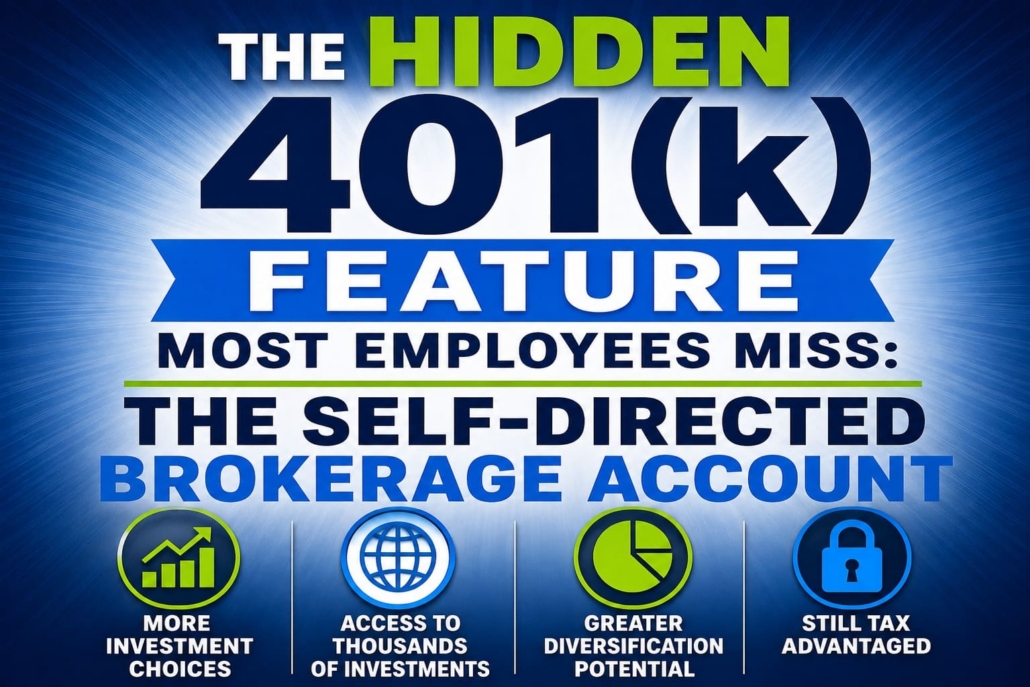
The Solution — The Hidden 401(k) Feature Most Employees Miss: The Self-Directed Brokerage Account
A self-directed brokerage account or SDBA (also known as a brokerage window) inside your 401(k) account allows you to invest in thousands of mutual funds, exchange traded funds (ETFs), bonds and stocks beyond your limited investment menu, while maintaining the tax advantages and benefits of your 401(k) account. Some plans may limit the amount you can invest in the SDBA to 50% to 100% of your assets and/or prohibit the use of ETFs and/or stocks. Some of the most common SDBAs are Fidelity Investment’s Fidelity BrokerageLink, Charles Schwab’s Schwab Personal Choice Retirement Account (PCRA) and Empower’s Empower SDBA.
Have Your 401(k), 403(b), 457(b) Account Professionally Managed
Top 5 Benefits of Self-Directed Brokerage Accounts
1. Massive Expansion of Investment Choices. The SDBA provides access to thousands of individual stocks, bonds, ETFs, real estate investment trusts (REITs), and mutual funds unavailable on your limited investment menu.
2. Access to No Expense Stocks, and Low-Expense ETFs and Index Funds. Many 401(k) plans, particularly small- to medium-sized company plans, contain actively managed mutual funds with poor performance, high expense ratios, and/or revenue-sharing fees.
The SDBA allows you to build portfolios using extremely low-cost, commission-free index mutual funds, ETFs (e.g., total market, S&P 500, MSCI EAFE, aggregate bond mutual funds and ETFs with expense ratios under 0.05%). Alpha measures the difference between an investment’s expected returns based on its beta and its actual returns. A positive alpha indicates the investment has performed better than its beta would predict. A negative alpha indicates an investment has underperformed, given the investment’s beta.
One of the top 20 most frequently offered mutual funds in 401(k) investment menus is a fund categorized as a “Large Growth” fund, according to Morningstar. The fund has a 0.59% expense ratio, standard deviation of 16.17 and a negative 1.47 alpha. Its 10-year total return for the period ending 12/31/25 was 238.15%. A similar “Large Growth” index ETF has a 0.04% expense ratio (translation: the ‘top 20 fund’ is almost 15 times more expensive), standard deviation of 16.69 and a positive 1.43 alpha. Its 10-year total return for the period ending 12/31/25 was 326.12%. While past performance does not necessarily predict future returns, it can tell you how volatile a fund has been. Generally, the more volatile a fund, the higher the investment risk. Alpha is excess return of an investment compared to a benchmark index, like the S&P 500, after adjusting for risk.
3. Optimal Asset Allocation. Core investment menus often lack coverage in asset classes, such as high-yield bonds, multisector bond funds, ultrashort bond funds, Nasdaq index funds, middle sized companies and small company stock funds.
The SDBA allows you to precisely optimize the asset allocation and risk level of your 401(k) account, utilizing investments unavailable in your basic investment menu, weighted to meet your risk tolerance and return objectives.
4. Tax-Sheltered Trading Inside the 401(k) Account. Trading inside a taxable brokerage account triggers short-term and/or long-term capital gains. Trading within the brokerage window of your 401(k) account maintains the exact same tax-deferred (Traditional) or tax-free (Roth) umbrella as the rest of your 401(k) plan. No tax reporting or capital gains events occur upon buying or selling assets inside the window.
5. Professional Management. Charles Schwab’s ‘2024 401(k) Participant Study’ found 61% of retirement savers believe their financial situation warrants professional advice. Vanguard’s 2022 ‘Putting a Value on Your Value: Quantifying Vanguard Advisor’s Alpha’ study concluded that professionally managed accounts can add 3% to 4% higher returns net of fees per year. The Vanguard study attributed the higher performance to the components listed in the article ‘Professionally Managed 401(k) Accounts Can Generate 3% to 4% Higher Returns Per Year’.
Your Registered Investment Adviser (RIA) can research the optimal investments among your thousands of choices, then build and manage your 401(k) to optimize your risk and return.
Action Step – Take Advantage of Your Self-Directed Brokerage Account
Work closely with your Registered Investment Adviser (RIA) to manage your self-directed brokerage account in your 401(k).
Aaron Skloff, Accredited Investment Fiduciary (AIF), Chartered Financial Analyst (CFA), Master of Business Administration (MBA) is CEO of Skloff Financial Group, a Registered Investment Advisory firm specializing in financial planning, investment management and benefits for small to middle sized companies. He can be contacted at www.skloff.com or 908-464-3060.

Have Your 401(k), 403(b), 457(b) Account Professionally Managed
Frequently Asked Questions
Q: What is a Self-Directed Brokerage Account (SDBA) in a 401(k) plan?
A Self-Directed Brokerage Account (SDBA) is a portal or feature within an employer-sponsored 401(k), 403(b), or 457(b) plan that allows participants to invest beyond the employer’s standard core menu of funds. While standard plan menus typically offer a limited selection of 15 to 30 pre-selected mutual funds or target-date funds, an SDBA links your retirement plan directly to a brokerage provider (such as Charles Schwab, Fidelity BrokerageLink, or TD Ameritrade/Schwab). This gives you access to thousands of individual stocks, bonds, Exchange Traded Funds (ETFs), mutual funds, and CDs within your tax-advantaged account.
Q: Why do employees choose an SDBA over standard 401(k) fund menus or Target-Date Funds?
Many employees switch to an SDBA to overcome the primary limitations of standard 401(k) lineups, such as:
Vast Investment Choice: You are no longer restricted to a narrow menu of 20–30 funds.
Avoiding One-Size-Fits-All Target-Date Funds: Standard target-date funds often suffer from rigid glide paths, inappropriate risk levels for individual goals, and higher embedded fee structures.
Cost Efficiency: Standard plan options may feature high expense ratios or legacy mutual fund share classes. An SDBA allows participants to buy low-cost index ETFs or individual securities.
Customization: It allows you to tailor an asset allocation strategy specifically to your risk tolerance, retirement timeline, tax situation, and overall financial plan.
Q: What are the main benefits of using an SDBA in your 401(k)?
Access to Thousands of Securities: Invest in individual stocks, sector ETFs, corporate/treasury bonds, and non-proprietary mutual funds.
Lower Investment Expenses: Ability to select ultra-low-cost index ETFs rather than high-expense actively managed mutual funds.
Professional Management Flexibility: Participants can work directly with an independent Registered Investment Advisor (RIA) or fiduciary advisor to manage their 401(k) investments within the plan.
Enhanced Diversification: Ability to invest in specific market sectors, international markets, or asset classes (e.g., commodities, real estate investment trusts) not offered in the standard menu.
Maintained Tax Advantages & Employer Match: Contributions made to the SDBA retain all traditional or Roth 401(k) tax-deferred benefits, as well as employee salary deferrals and company matching contributions.
Q: Are there any risks, restrictions, or extra fees associated with an SDBA?
Yes. While SDBAs offer significant freedom, they come with considerations:
Trading & Account Fees: Some custodians charge account maintenance fees, transaction fees, or commissions on certain trades (e.g., specific mutual funds or stock trades).
Plan Transfer Limits: Many employer plans restrict how much of your balance can be transferred into the SDBA (e.g., capping it at 50% to 95% of your total account balance, requiring the rest to remain in core funds).
Restricted Assets: Highly speculative investments like options, futures, short selling, and leveraged crypto assets are generally prohibited by plan rules and Department of Labor guidelines.
Investment Risk: With greater choice comes the risk of poor diversification or emotional trading if the account is unmanaged or self-directed without a disciplined strategy.
Q: How do contributions and company matches work with an SDBA?
Your payroll deductions and employer matching contributions always deposit into your primary 401(k) core account first. Once the funds land in your main account, you can execute a transfer or set up automated transfers to move funds into your SDBA window to execute your trading strategy. You retain all employer match funds and vesting schedules regardless of whether your money sits in the core menu or the SDBA.
Q: How do I find out if my employer offers an SDBA, and how do I open one?
Check Your Summary Plan Description (SPD): Review your plan documents or log in to your 401(k) participant portal (e.g., Fidelity, Schwab, Empower, Vanguard). Look for terms like BrokerageLink, Self-Directed Brokerage, or Brokerage Window.
Contact HR or Plan Administrator: Ask if your 401(k) plan permits self-directed brokerage options and whether third-party fiduciary advisors are allowed to manage it for you.
Enroll & Transfer: If available, you will complete an online enrollment to establish the linked brokerage account, after which you can transfer existing assets from your core menu into the SDBA.