
Skloff Financial Group
  • Home
  • About
    • Advisor Biography
    • How We Are Different
    • The Company
    • The Process
  • Financial Planning
    • College Planning
    • Estate Planning
    • Retirement Planning
    • Tax Planning
  • Wealth Management
    • 401(k), 403(b), 457(b) Account Management
    • 401(k), 403(b), 457(b) Rollover to an IRA
    • Top Five 401(k) Mistakes
    • Investment Management
    • Trust Management
    • Amazon 401(k)
    • Broadcom 401(k)
    • Cisco 401(k)
    • Google 401(k)
    • Meta 401(k)
    • Micron 401(k)
    • Microsoft 401(k)
    • NVIDIA 401(k)
    • Oracle 401(k)
    • Palo Alto Networks 401(k)
    • Qualcomm 401(k)
    • Salesforce 401(k)
    • Uber 401(k)
    • Workday 401(k)
  • Insurance
    • Annuities
    • Disability Insurance
    • Life Insurance
    • Long Term Care Insurance
  • Group Benefits
    • 401(k) Plans
    • 403(b) Plans
    • 457(b) Plans
    • Insurance Plans
  • Blog
  • Contact
  • Click to open the search input field Click to open the search input field Search
  • Menu Menu

How Community Property Versus Separate Property States Can Be a Tax Dream or a Tax Nightmare – Part 1

Money Matters – Skloff Financial Group Question of the Month – September 1, 2024

By Aaron Skloff, AIF, CFA, MBA

Q: We read ‘How a Gift Can Be a Tax Dream or a Tax Nightmare’ Part 1 and Part 2. We also read ‘How To (Legally) Avoid Taxes When Selling Your Home’ Part 1, Part 2  and Part 3. Lastly, we read ‘How Gifting Versus Selling Your Home Can Be a Tax Dream or a Tax Nightmare’ Part 1, Part 2 and Part 3. Lastly, we read ‘How a Step-Up in Basis Can Be a Tax Dream’ Part 1, Part 2 and Part 3. What are the key similarities and differences between community property and separate property states?

The Problem – Understanding the Key Differences Between Community Property and Separate Property States Can Be Confusing

What’s mine is yours and what’s yours is mine, in marriage, right? Like many financial questions, the answer depends on the circumstances.

The Solution – Understanding the Key Differences Between Community Property and Separate Property States

Whether it is estate planning, marital planning or tax planning, understanding the key differences between community property and separate property is critically important to develop the best plan.  Let’s examine the definitions of community property and separate property below.

Are You Interested in Learning More?

Community Property.  Community property are assets acquired during a marriage by either spouse.  In a community property state, property (assets) acquired by either spouse during the marriage belong to both spouses equally, regardless of who purchased the property.  Not all states recognize community property. See the map below.

Exceptions to the Community Property Rule.  There are three exceptions to the community property rules.

1. Property Owned Before the Marriage. The assets that you owned before your marriage are separate property. If you commingle the assets with your spouse, they can become community property.  For example, if you had a savings account in your own name before your marriage and you move the money into a joint account with your spouse after your marriage, that asset can become community property.

2. Gifts. If you receive a gift specifically designated to one person during your marriage, that asset is separate property, not community property. Even if the gift came from one spouse’s parent, if it is meant for both of you during your marriage, it will be community property.

3. Inherited Property. If you inherit property during your marriage, where the will or trust specifically designates you as the beneficiary, the property is separate property – not community property. If you commingle the assets with your spouse, they can become community property.

Separate Property.  Separate property are assets acquired before a marriage by either spouse.  Property gifted to or inherited by one spouse before or during the marriage is separate property.  Property acquired by one spouse in their own name with their own income or assets during the marriage is separate property.  Most states recognize the common law property system, where property acquired by a married person during marriage is the property of that person separately, unless the person agrees with his or her spouse to hold the property jointly.  Not all states recognize separate property.  See the map below.

Click to Enlarge
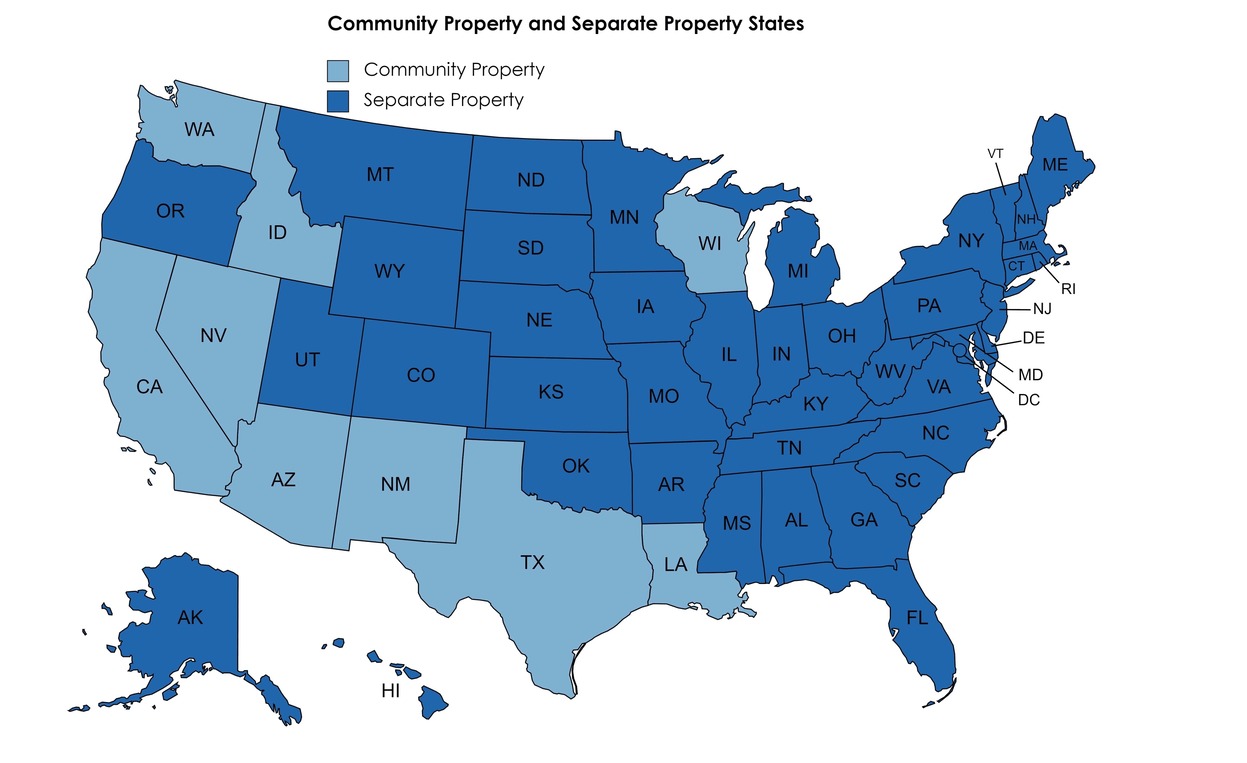
Community Property States

Arizona

California

Idaho

Louisiana

Nevada

New Mexico

Texas

Washington

Wisconsin

Alaska allows for “opt in” community property

Action Steps

Work closely with your Registered Investment Adviser (RIA) to reduce your taxes, and grow and preserve your wealth.

Aaron Skloff, Accredited Investment Fiduciary (AIF), Chartered Financial Analyst (CFA), Master of Business Administration (MBA) is CEO of Skloff Financial Group, a Registered Investment Advisory firm specializing in financial planning, investment management and benefits for small to middle sized companies. He can be contacted at www.skloff.com or 908-464-3060.

Adobe-PDF-Document-icon

Are You Interested in Learning More?

Tags: Adjusted Basis, capital gains exemption, capital gains tax, common law, community property, Effective Tax Rate, Estate Planning, Financial Planning, gifting, Gifts, HSA, investment surtax, IRS, Kiddie Tax, long term capital gains, Marginal Tax Rate, Public Law No: 115-97, separate property, short term capital gains, step-up in basis, stepped-up costs basis, Tax Cuts and Jobs Act, Tax Free, Tax Planning, Taxes, Taxpayer Relief Act of 1997, TRA97
https://skloff.com/wp-content/uploads/2016/12/Couple-riding-bikes-91342001.jpg 749 1124 Aaron Skloff, AIF, CFA, MBA https://skloff.com/wp-content/uploads/2025/10/sfg-8.png Aaron Skloff, AIF, CFA, MBA2024-09-01 12:00:562025-10-08 18:38:49How Community Property Versus Separate Property States Can Be a Tax Dream or a Tax Nightmare – Part 1
You might also like
How Gifting Versus Selling Your Home Can Be a Tax Dream or a Tax Nightmare – Part 2
Income Tax and Capital Gains Rates 2022
Social Security Basics – What You Need to Know
How to Retire When You Want – Kiplinger’s Personal Finance
Long Term Care Insurance Tax Free with Health Savings Account (HSA) – Long Term Care University
Global Atlantic Forethought ForeCare Hybrid Combination Annuity and Long Term Care Insurance Review – Long Term Care University
Are Indexed Universal Life (IUL) Insurance Policies as Good as They Sound? – Part 1
Long Term Care Insurance Informal and Formal Care – Long Term Care University
Search Search
HTML Button Generator

Categories

  • – ARTICLES CATEGORIES
    • 401(k)
    • College Planning
    • Disability Insurance
    • Estate Planning
    • Financial Planning
    • Investing
    • IRA
    • Life Insurance
    • Long Term Care Insurance
    • Retirement Planning
    • Social Security
    • Taxes
  • – SLIDES CATEGORIES
    • 401(k)
    • College Planning
    • Estate Planning
    • Financial Planning
    • Investing
    • IRA
    • Life Insurance
    • Long Term Care Insurance
    • Retirement Planning
    • Social Security
    • Taxes
  • – VIDEOS CATEGORIES
    • 401(k)
    • College Planning
    • Disability Insurance
    • Estate Planning
    • Financial Planning
    • Investing
    • IRA
    • Life Insurance
    • Long Term Care Insurance
    • Retirement Planning
    • Social Security
    • Taxes

(c) Copyright 2026
Skloff Financial Group
7682 Santa Margherita Way
Naples, FL 34109
908-464-3060

Featured Content

Income Tax and Capital Gains Rates 2026
Retirement Plan Contribution Limits 2026
IRA Contribution and Income Limits 2026
Hybrid Life and Long Term Care Insurance

Information

CRS
Disclosures
Privacy Policy

HTML Button Generator
Link to: 5 Questions With Fidelity: Funding Long-Term Care – Fidelity Investments Link to: 5 Questions With Fidelity: Funding Long-Term Care – Fidelity Investments 5 Questions With Fidelity: Funding Long-Term Care – Fidelity Investme... Link to: How Community Property Versus Separate Property States Can Be a Tax Dream or a Tax Nightmare – Part 2 Link to: How Community Property Versus Separate Property States Can Be a Tax Dream or a Tax Nightmare – Part 2 How Community Property Versus Separate Property States Can Be a Tax Dream or...
Scroll to top Scroll to top Scroll to top