
How to Get the Most Out of Trump Accounts – Part 2
Money Matters – Skloff Financial Group Question of the Month – November 1, 2026
By Aaron Skloff, AIF, CFA, MBA
Q: We read ‘How to Get the Most Out of Trump Accounts’ Part 1. Can you further explain the accumulation and distribution phases of Trump Accounts and how to get the most out of them?
The Problem — Building Wealth and Avoiding Unnecessary Taxes with Trump Accounts
The true financial advantage of Trump Accounts lies not solely in the accumulation phase, but in how distributions and Roth conversions are orchestrated across a beneficiary’s early adulthood. A poorly executed strategy can trigger substantial, unnecessary taxes.
The Solution — Optimizing the Accumulation and Distributions Phases of Trump Accounts
Authorized under Internal Revenue Code (IRC) Section 530A, Trump Accounts represent a breakthrough in child savings and tax-sheltered wealth accumulation. By pairing federal pilot funding with private after-tax contributions during childhood, Section 530A creates a powerful investment vehicle. To achieve maximum tax efficiency, account holders must navigate three distinct life, career, and tax phases – transitioning pre-tax earnings into a fully tax-free Roth IRA while minimizing lifetime taxes.
Are You Interested in Learning More?
1. Accumulation Phase (Ages 1–17): Building Basis and Tax-Deferred Growth
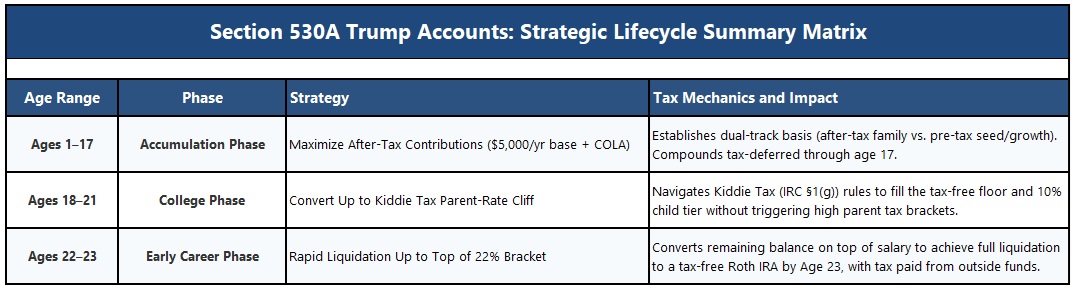
The foundation of Section 530A begins at birth. Every eligible child receives a one-time pre-tax government pilot contribution of $1,000 in Year 1, establishing an initial pre-tax balance with zero tax basis. Parents, grandparents, and relatives can supplement this seed with after-tax contributions up to $5,000 per year (adjusted periodically for inflation rounded down to the nearest $100 per IRC §530A(c)(2)(B)).
During this 17-year horizon, assets compound tax-deferred. Critically, Section 530A accounts establish a dual-track accounting structure:
- Non-Taxable Cost Basis: Created strictly by after-tax family contributions.
- Taxable Pre-Tax Portion: Composed of the government seed plus all cumulative investment growth.
Under IRS pro-rata rules, every distribution or Roth conversion carries a proportional mix of tax-free basis recovery and taxable income.
The Strategic Triad – Maximum Tax Optimization Across Adult Tiers
Upon reaching adulthood at age 18, the strategy transitions from accumulation to systematic Roth conversions. Because converting traditional account balances into a Roth IRA triggers ordinary income tax on the taxable growth portion, timing conversions is essential.
2. College Phase (Ages 18–21): Navigating Kiddie Tax Rules
While the child is a full-time student and claimed as a dependent, unearned income from conversions is governed by the Kiddie Tax (IRC §1(g)). Under these rules, conversion income first fills a tax-free unearned floor and a 10% child-rate tier. However, converting beyond the Kiddie Tax parent-rate cliff triggers the parents’ higher marginal rate. The optimization strategy executes systematic conversions capped precisely at the parent cliff, harvesting tax-free basis recovery and low-bracket growth while completely avoiding parent rate spikes.
3. Early Career Phase (Ages 22–23): Rapid Liquidation and Lifetime Roth Rollover
When the young adult enters the workforce and earns a starting salary, Kiddie Tax rules expire. Assuming an 8% average annual return, attempting a slow, prolonged conversion schedule fails as ongoing growth outpaces lower bracket room. Instead, the strategy executes rapid conversions on top of salary up to the top of the 22% bracket. This completely liquidates the traditional account to $0 by Age 23. Paying the resulting conversion tax from outside family gifts avoids early withdrawal penalties, securing decades of tax-exempt compounding inside a Roth IRA.
Action Step – Get the Most Out of Trump Accounts
Work closely with your Registered Investment Adviser (RIA) to optimize your contributions and withdrawals from Trump Accounts in the context of your financial plan.
Aaron Skloff, Accredited Investment Fiduciary (AIF), Chartered Financial Analyst (CFA), Master of Business Administration (MBA) is CEO of Skloff Financial Group, a Registered Investment Advisory firm specializing in financial planning, investment management and benefits for small to middle sized companies. He can be contacted at www.skloff.com or 908-464-3060.

Are You Interested in Learning More?
Frequently Asked Questions
Q: What is a Trump Account and how does it function during the accumulation phase?
A Trump Account (established under Section 530A of the Internal Revenue Code) is a custodial savings vehicle designed to build long-term wealth for minor children who do not need earned income to participate. During the accumulation phase (birth through age 17), parents or legal guardians act as custodians, and funds can be invested in low-cost U.S. index funds. Eligible children born between 2025 and 2028 receive a one-time, pre-tax $1,000 government seed deposit. Private contributions are made with after-tax dollars up to an annual limit of $5,000 per beneficiary across all individual and employer sources, and the account grows tax-deferred throughout childhood.
Q: How do employer contributions interact with a Trump Account’s contribution caps?
Employers can contribute up to $2,500 annually per employee’s child into a Trump Account as a tax-advantaged fringe benefit. While employer contributions receive favorable tax treatment, baseline IRS rules dictate that these contributions count directly toward the beneficiary’s overall $5,000 annual contribution cap rather than expanding it. Consequently, if an employer contributes $2,500 to a child’s account in a given year, the remaining maximum private contribution room from parents, family, or friends for that tax year is $2,500.
Q: What transition occurs when the beneficiary reaches 18 years of age?
On January 1st of the year the child turns 18, the custodial structure terminates, and full legal ownership transitions directly to the young adult. At this milestone, the account shifts to distribution phase rules and is treated primarily like a Traditional IRA. While the individual gains total authority to manage or withdraw the funds, standard tax provisions apply: early withdrawals taken before age 59½ for non-qualified purposes incur ordinary income taxes along with a 10% early withdrawal penalty.
Q: How are withdrawals taxed under the pro-rata tax structure?
When distributions are taken from a Trump Account, they do not default to taking out non-taxable contributions first. Instead, the tax code applies a pro-rata taxation structure that divides every distribution into taxable and non-taxable portions based on the ratio of cost basis to total balance. The non-taxable portion represents the original after-tax parent/family contributions. Conversely, the taxable portion includes all investment growth, employer pre-tax contributions, and the initial $1,000 government seed contribution, all of which are subject to ordinary income tax upon withdrawal.
Q: Why is the Post-18 Roth Conversion Strategy effective for maximizing Trump Accounts?
A prominent financial planning strategy to maximize a Trump Account involves executing a Roth IRA conversion shortly after the child turns 18. Because young adults typically sit in lower federal income tax brackets, paying ordinary income tax to convert the pre-tax seed funds and tax-deferred earnings into a Roth IRA generates minimal tax exposure. Once converted, the entire balance transitions into a Roth IRA, locking in tax-free growth and tax-free qualified distributions for the remaining 50+ years of the beneficiary’s life.
Q: How do Trump Accounts differ from traditional 529 College Savings Plans?
While both vehicles encourage long-term savings for minors, they serve distinct purposes and offer different tax treatments. 529 plans feature significantly higher contribution caps and allow tax-free withdrawals specifically for qualified education expenses, but non-qualified distributions face taxes and a 10% penalty on earnings. Trump Accounts, on the other hand, have a $5,000 annual limit, convert to Traditional IRA tax rules at age 18, and offer broader long-term post-adulthood utility (such as retirement, home purchases, or early-adulthood Roth conversions) rather than being limited exclusively to educational costs.