

How to Get the Most Out of Trump Accounts – Part 3
Money Matters – Skloff Financial Group Question of the Month – November 1, 2026
By Aaron Skloff, AIF, CFA, MBA
Q: We read ‘How to Get the Most Out of Trump Accounts’ Part 1 and Part 2. Can you give an example of the accumulation and distribution phases of Trump Accounts and how to get the most out of them?
The Problem — Navigating Complex Tax Rules and Compound Growth of Trump Accounts
While Part 1 and Part 2 established the foundational rules of Section 530A Trump Accounts, achieving maximum wealth transfer requires a precise mathematical roadmap. Without proactive execution, ongoing investment growth inside the account quickly outpaces lower tax brackets, forcing high-tax distributions later in adulthood.
The Solution — Optimizing the Accumulation and Distribution Phases of Trump Accounts
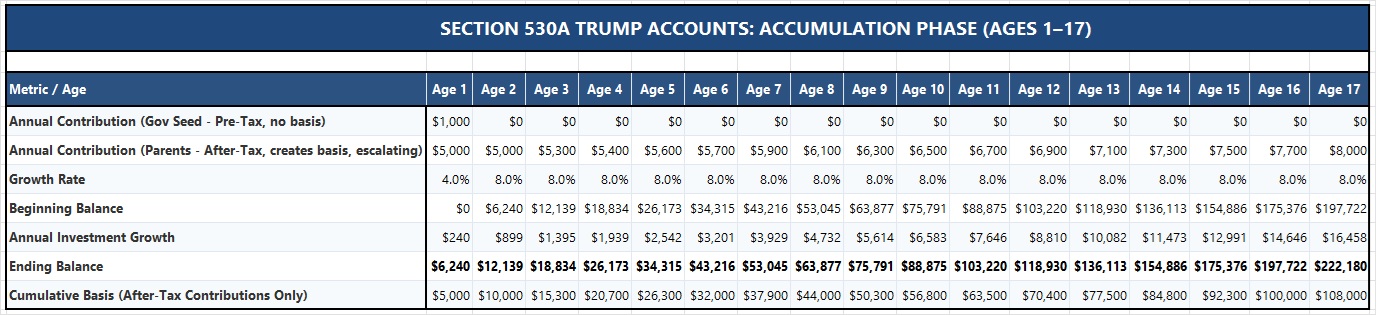
To achieve complete tax efficiency, account holders must orchestrate a 3-Phase lifecycle strategy. Our numerical model assumes a $1,000 government seed, $5,000 base family contributions escalating with inflation per IRC §530A(c)(2)(B), an 8% average return, and a starting college graduate salary of $61,532 (median for 2026, inflated at 3% per year).
Are You Interested in Learning More?
1. Accumulation Phase (Ages 1–17): Building Basis and Tax-Deferred Growth
Family contributions scale from $5,000 to $8,000 annually, building $108,000 in non-taxable cost basis. At an 8% return, the total account compounds tax-deferred to $222,180 by Age 17. Under IRS pro-rata rules, each conversion carries a proportional mix of tax-free cost basis (48.6%) and taxable pre-tax earnings/seed (51.4%).
Click to Enlarge
The Strategic Triad — Systematic Roth Conversions Across Early Adulthood
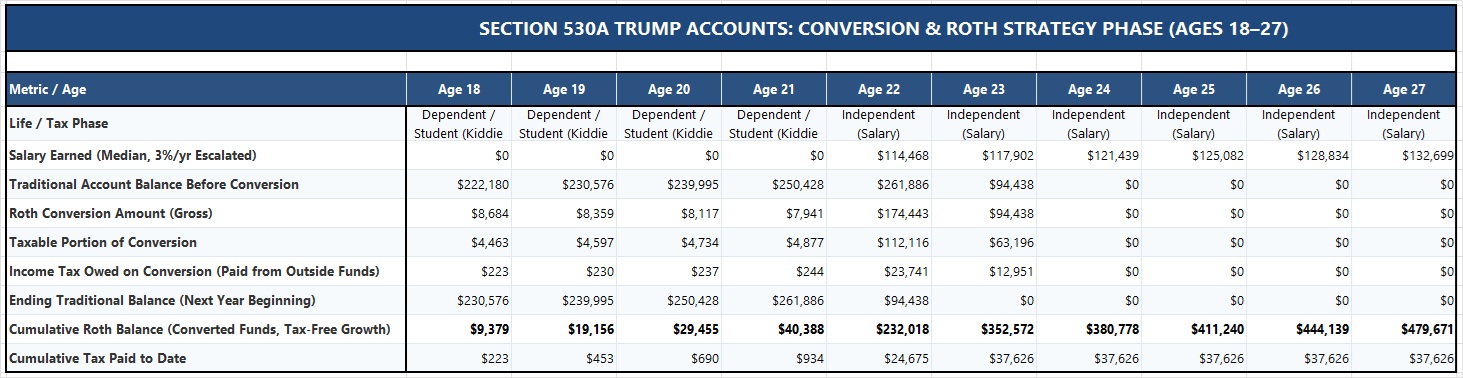
2. College Phase (Ages 18–21): Navigating Kiddie Tax Rules — Conversions are capped precisely at the Kiddie Tax parent-rate cliff ($4,463–$4,877 taxable income), filling the 0% floor and 10% child tier ($934 total tax across 4 years; 2.8% rate) while completely avoiding parent rate spikes.
3. Early Career Phase (Ages 22–23): Rapid Liquidation and Lifetime Roth Rollover — Entering the workforce at a $114,468 starting salary, conversions fill up to the top of the 22% bracket ceiling. This completely liquidates the traditional account balance to $0 by Age 23 ($37,626 total lifetime tax paid from outside family gifts).
Post-Age 23 Lifetime Compounding — With the traditional account fully converted to $0, $0 in further conversion taxes is ever owed. The Roth IRA continues to compound 100% tax-free, growing from $275,000+ at Age 23 to over $370,000+ by Age 27 and millions by retirement
Click to Enlarge
Action Step – Get the Most Out of Trump Accounts
Work closely with your Registered Investment Adviser (RIA) to optimize your contributions and withdrawals from Trump Accounts in the context of your financial plan.
Aaron Skloff, Accredited Investment Fiduciary (AIF), Chartered Financial Analyst (CFA), Master of Business Administration (MBA) is CEO of Skloff Financial Group, a Registered Investment Advisory firm specializing in financial planning, investment management and benefits for small to middle sized companies. He can be contacted at www.skloff.com or 908-464-3060.

Are You Interested in Learning More?
Frequently Asked Questions
Q: What are Trump Accounts, and who is eligible for the $1,000 government seed contribution?
Trump Accounts (authorized under Internal Revenue Code Section 530A) are tax-advantaged savings and investment vehicles created to help build long-term wealth for children. An eligible child—generally a U.S. citizen born between 2025 and 2028—receives a one-time, pre-tax $1,000 pilot program contribution deposited directly into the account by the U.S. Treasury. Parents or legal guardians must submit IRS Form 4547 to establish and activate the account, after which they manage the funds on behalf of the child until the child reaches age 18.
Q: How do private contributions work, and what are the annual limits?
Parents, relatives, or other authorized individuals can contribute up to $5,000 annually in private, after-tax funds to a child’s Trump Account. This annual cap is designed to encourage broad participation across middle- and lower-income families while preventing high-net-worth individuals from abusing the accounts as tax shelters. Additionally, starting after 2027, the $5,000 limit will be indexed periodically to keep up with inflation.
Q: How are investments in a Trump Account structured and taxed during the child’s minor years?
Contributions made to a Trump Account grow on a tax-deferred basis, meaning earnings are not taxed as they accumulate over time. Private contributions are held as non-taxable cost basis, whereas government seed money and investment gains represent the taxable portion of the account. If qualified stock contributions are made, temporary Treasury regulations enforce a minimum 5-year holding period before those specific assets can be distributed or converted penalty-free.
Q: What happens to the Trump Account when the child turns 18?
On January 1 of the calendar year the child turns 18, control of the account transitions entirely to the young adult, and the account begins following standard Traditional IRA rules. From this point forward, ongoing contributions, investment options, and distributions adhere to traditional retirement account guidelines. This design ensures that the funds serve as an early-start retirement and long-term wealth engine rather than a short-term checking account.
Q: How do Trump Accounts differ from 529 College Savings Plans and Custodial Accounts (UGMA/UTMA)?
Unlike 529 plans, which offer tax-free distributions specifically for qualified education expenses, Trump Accounts operate as retirement savings vehicles subject to early-withdrawal penalties for non-retirement distributions once the child turns 18. Compared to traditional custodial accounts (UGMA/UTMA), which are flexible but frequently subject to the “Kiddie Tax” on annual unearned income, Trump Accounts shield growth from taxes until withdrawals occur and come with a $1,000 federal boost.
Q: What are the rules regarding account transfers and rollovers?
A child is permitted to have only one active, funded Trump Account at any given time. If a parent or guardian chooses to transfer or roll over funds to another provider, trustee-to-trustee transfers must include the entire account balance rather than partial amounts. This rule simplifies reporting and ensures compliance with annual limits across financial institutions.