

Income Tax and Capital Gains Rates 2020

Money Matters – Skloff Financial Group Question of the Month – March 1, 2020
By Aaron Skloff, AIF, CFA, MBA
Q: Our taxes are confusing. What are the income tax rates and capital gains rates for 2020, following the Tax Cuts and Jobs Act?
The Problem – Maze of Tax Rates on Income and Capital Gains
Not all sources of your income are the same in the eyes of the IRS. The IRS treats your wages differently than income you earn on your investments. The IRS also treats interest on your savings account and bonds differently than dividends on your stocks and funds, and the gains you realize on your stocks and funds. This creates a ‘maze’ of different rates for different circumstances.
Are You Interested in Learning More?

The Solution – A Map for the Maze of Tax Rates on Income and Capital Gains
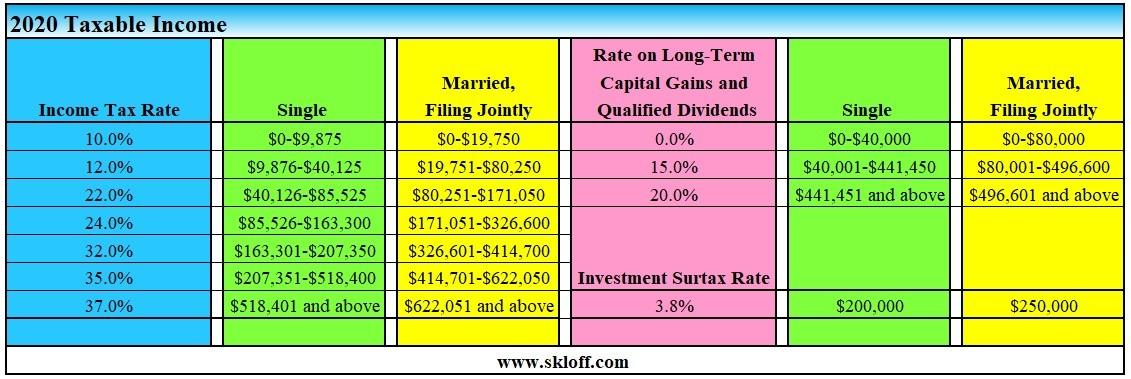
There are a number of factors that could impact the taxes you pay on your income and investments. The following table provides income tax and capital gains rates for single filers and those married, filing jointly.
Click to Enlarge
Income and Income Taxes
For many taxpayers, their primary source of income is their wages. For others, it may be pension or social security income and/or retirement account withdrawals (RMDs or otherwise). Others may rely on savings account and bond interest. Most taxpayers can aggregate income from wages, pensions, social security and interest to determine their total income. Your total taxable income can be impacted by a number of factors, including, but not limited to: alimony payments, contributions to employer retirement plans and/or IRAs, contributions to HSAs, deductions (standard or itemized) and credits. These adjustments to your income result in your taxable income.
Standard Deduction
The 2020 standard deduction is to $24,800 for those married and filing jointly and $12,400. Like a contribution to a pre-tax qualified retirement plan (i.e.: 401(k), 403(b), 457(b)) or IRA, a standard deduction reduces your taxable income.
Marginal Income Tax Brackets and Effective Income Tax Rate
Although the top marginal income tax rate of 37% is assessed on taxpayers with taxable income of $518,401 and higher for single filers and $622,051 and higher for married couples filing jointly, the actual tax rate paid is the effective income tax rate. The effective income tax rate is the blended rate you actually pay. Based on the table above, a single filer with taxable income of $85,525 would have a top marginal income tax rate of 22% and an effective income tax rate of approximately 17%. The first $9,875 of taxable income would be taxed at 10%, the next $30,249 (from $9,876 to $40,125) would be taxed at 12% and the last $45,399 (from $40,126 to $85,525) would be taxed at 22%.
Capital Gains and Qualified Dividends
Many taxpayers also own stocks, bond, mutual funds, exchange traded funds and other investments. If you receive a qualified dividend or buy and sell an investment for a gain outside of a tax sheltered account, you may be subject to a qualified dividend tax or capital gains tax. Short term capital gains (365 days or less) are taxed at ordinary income tax rates. Long term capital gains (366 days or more) are taxed at the rates in the table above. For example, a single filer with taxable income of $40,000 would have a 0% qualified dividend rate and a 0% long term capital gains rate.
Investment Surtax
Single filers with taxable income of $200,000 or higher and those married filing jointly with taxable income of $250,000 or higher are further penalized with an investment surtax (net investment income tax). The investment surtax rate is 3.8% on income from investments, including, but not limited to: interest, dividends, short and long-term capital gains, rental income, royalty income and passive business income.
Action Steps
With a map for the maze of income taxes and capital gains taxes, you can better prepare yourself for the 2020 tax season. Work closely with your Registered Investment Adviser (RIA) and tax professional throughout 2020 to optimize all the factors that impact your taxes.
Aaron Skloff, Accredited Investment Fiduciary (AIF), Chartered Financial Analyst (CFA), Master of Business Administration (MBA) is CEO of Skloff Financial Group, a Registered Investment Advisory firm. He can be contacted at www.skloff.com or 908-464-3060.

Are You Interested in Learning More?