

Skloff Financial Group
  • Home
  • About
    • Advisor Biography
    • How We Are Different
    • The Company
    • The Process
  • Financial Planning
    • College Planning
    • Estate Planning
    • Retirement Planning
    • Tax Planning
  • Wealth Management
    • 401(k), 403(b), 457(b) Account Management
    • 401(k), 403(b), 457(b) Rollover to an IRA
    • Top Five 401(k) Mistakes
    • Investment Management
    • Trust Management
    • Amazon 401(k)
    • Broadcom 401(k)
    • Cisco 401(k)
    • Google 401(k)
    • Meta 401(k)
    • Micron 401(k)
    • Microsoft 401(k)
    • NVIDIA 401(k)
    • Oracle 401(k)
    • Palo Alto Networks 401(k)
    • Qualcomm 401(k)
    • Salesforce 401(k)
    • Uber 401(k)
    • Workday 401(k)
  • Insurance
    • Annuities
    • Disability Insurance
    • Life Insurance
    • Long Term Care Insurance
  • Group Benefits
    • 401(k) Plans
    • 403(b) Plans
    • 457(b) Plans
    • Insurance Plans
  • Blog
  • Contact
  • Click to open the search input field Click to open the search input field Search
  • Menu Menu

Income Tax and Capital Gains Rates 2026 – Part 2

Money Matters – Skloff Financial Group Question of the Month – April 1, 2026

By Aaron Skloff, AIF, CFA, MBA

Q: We read ‘Income Tax and Capital Gains Rates 2026’ Part 1.  Can you give examples of marginal and effective income tax rates?

The Problem – Maze of Marginal and Effective Income Tax Rates

Looking at an income tax rates table may lead some to belief all their income is taxed at the top marginal income tax bracket.

Are You Interested in Learning More?

The Solution – A Side-by-Side Comparison of Marginal and Effective Income Tax Rates

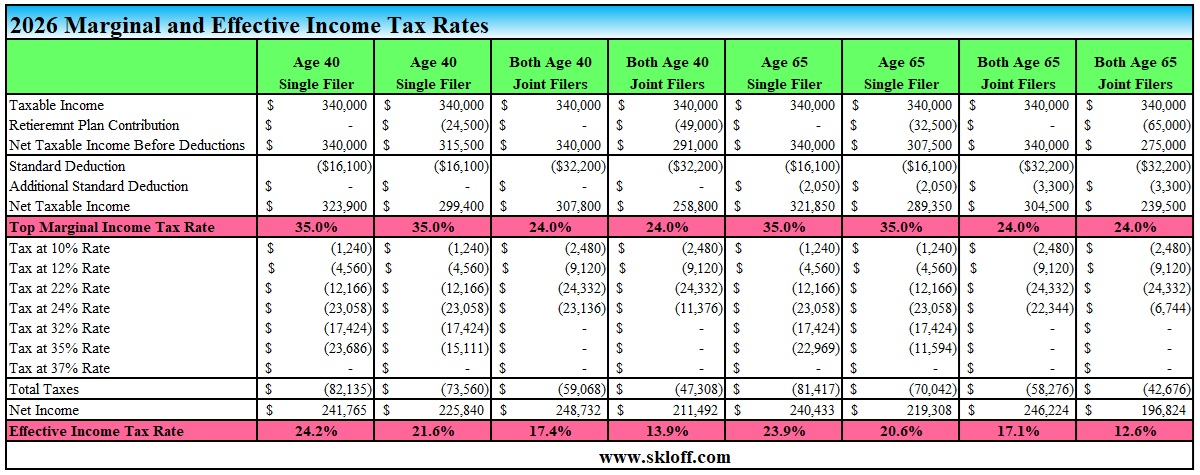
By examining scenarios on a side-by-side basis, we can see how age, adjustments to income, standard deductions and filing status can affect income taxes.  The 2026 standard deduction for single filers under age 65 is $16,100, with an additional $2,000, plus for those age 65 an over plus up to an additional $6,000 based on income for those 65 and over.  The 2026 standard deduction for joint filers under age 65 is $32,200, with an additional $3,300 for those 65 and over, plus up to an additional $12,000 based on income for those 65 and over.  The 2026 maximum pre-tax contribution limit to many employer retirement plans (i.e.: 401(k), 403(b) and 457(b) is $24,500 for those under age 50, $32,500 for those 50-59 or 64+, and $35,750 for those 60-63.  The following scenarios are based on taking the standard deduction.

Age 40 Single Filer Not Contributing Versus Maximizing Contributions to a Retirement Plan.  A 40-year-old single filer with $340,000 of income would be subject to a 35% top marginal income tax bracket.  If he does not contribute to his employer retirement plan, he will pay $82,135 in taxes and have a 24.2% effective income tax rate.  If he maximizes contributions to his employer retirement plan, he will pay $73,560 in taxes and have a 21.6% effective income tax rate.

Both Age 40 Joint Filers Not Contributing Versus Maximizing Contributions to a Retirement Plan.  Two 40-year-old joint filers with $340,000 of combined income would be subject to a 24% top marginal income tax bracket.  If they do not contribute to their company retirement plan, they will pay $59,068 in taxes and have a 17.4% effective income tax rate.  If they maximize contributions to their employer retirement plan, they will pay $47,308 in taxes and have a 13.9% effective income tax rate.

Age 65 Single Filer Not Contributing Versus Maximizing Contributions to a Retirement Plan.  A 65-year-old single filer with $340,000 of income would be subject to a 35% top marginal income tax bracket.  If he does not contribute to his employer retirement plan, he will pay $81,417 in taxes and have a 23.9% effective income tax rate.  If he maximizes contributions to his employer retirement plan, he will pay $70,042 in taxes and have a 20.6% effective income tax rate.

Both Age 65 Joint Filers Not Contributing Versus Maximizing Contributions to a Retirement Plan.  Two 65-year-old joint filers with $340,000 of combined income would be subject to a 24% top marginal income tax bracket.  If they do not contribute to their company retirement plan, they will pay $58,276 in taxes and have a 17.1% effective income tax rate.  If they maximize contributions to their employer retirement plan, they will pay $42,676 in taxes and have a 12.6% effective income tax rate.

Click to Enlarge
Action Steps

Work closely with your Registered Investment Adviser (RIA) to optimize your marginal income tax brackets to pay the lowest effective income tax rates in the current tax year and future tax years.

Aaron Skloff, Accredited Investment Fiduciary (AIF), Chartered Financial Analyst (CFA), Master of Business Administration (MBA) is CEO of Skloff Financial Group, a Registered Investment Advisory firm. He can be contacted at www.skloff.com or 908-464-3060.

Adobe-PDF-Document-icon


Are You Interested in Learning More?

Tags: capital gains tax, Effective Tax Rate, Financial Planning, HSA, investment surtax, IRA, IRS, long term capital gains, Marginal Tax Rate, Public Law No: 115-97, short term capital gains, Tax Cuts and Jobs Act, Tax Free, Tax Planning, Taxes
https://skloff.com/wp-content/uploads/2016/12/Taxes-This-Way-62476802.jpg 692 1037 Aaron Skloff, AIF, CFA, MBA https://skloff.com/wp-content/uploads/2025/10/sfg-8.png Aaron Skloff, AIF, CFA, MBA2026-04-01 12:00:502026-04-01 17:52:18Income Tax and Capital Gains Rates 2026 – Part 2
You might also like
The Rhode Island Long-Term Care Insurance Partnership Program – Long Term Care University
The Cost of Care – Planning to Afford the Unknown
Securian Minnesota Life SecureCare IV Hybrid Life and Long Term Care Insurance Review – Long Term Care University
Income Tax and Capital Gains Rates 2016
How an Irrevocable Life Insurance Trust Can Be a Tax Dream – Part 1
Lincoln MoneyGuard III Hybrid Life and Long Term Care Insurance Review – Long Term Care University
Health Savings Accounts (HSAs) Explained – 5 Questions – Fidelity Investments
Genworth Long Term Care Stories: Sandy Rockwood
Search Search
HTML Button Generator

Categories

  • – ARTICLES CATEGORIES
    • 401(k)
    • College Planning
    • Disability Insurance
    • Estate Planning
    • Financial Planning
    • Investing
    • IRA
    • Life Insurance
    • Long Term Care Insurance
    • Retirement Planning
    • Social Security
    • Taxes
  • – SLIDES CATEGORIES
    • 401(k)
    • College Planning
    • Estate Planning
    • Financial Planning
    • Investing
    • IRA
    • Life Insurance
    • Long Term Care Insurance
    • Retirement Planning
    • Social Security
    • Taxes
  • – VIDEOS CATEGORIES
    • 401(k)
    • College Planning
    • Disability Insurance
    • Estate Planning
    • Financial Planning
    • Investing
    • IRA
    • Life Insurance
    • Long Term Care Insurance
    • Retirement Planning
    • Social Security
    • Taxes

(c) Copyright 2026
Skloff Financial Group
7682 Santa Margherita Way
Naples, FL 34109
908-464-3060

Featured Content

Income Tax and Capital Gains Rates 2026
Retirement Plan Contribution Limits 2026
IRA Contribution and Income Limits 2026
Hybrid Life and Long Term Care Insurance

Information

CRS
Disclosures
Privacy Policy

HTML Button Generator
Link to: Insure or Self-Insure for Long Term Care? – Part 1 – Long Term Care University Link to: Insure or Self-Insure for Long Term Care? – Part 1 – Long Term Care University Insure or Self-Insure for Long Term Care? – Part 1 – Long Term Care... Link to: Income Tax and Capital Gains Rates 2026 – Part 3 Link to: Income Tax and Capital Gains Rates 2026 – Part 3 Income Tax and Capital Gains Rates 2026 – Part 3
Scroll to top Scroll to top Scroll to top