

Skloff Financial Group
  • Home
  • About
    • Advisor Biography
    • How We Are Different
    • The Company
    • The Process
  • Financial Planning
    • College Planning
    • Estate Planning
    • Retirement Planning
    • Tax Planning
  • Wealth Management
    • 401(k), 403(b), 457(b) Account Management
    • 401(k), 403(b), 457(b) Rollover to an IRA
    • Top Five 401(k) Mistakes
    • Investment Management
    • Trust Management
    • Amazon 401(k)
    • Broadcom 401(k)
    • Cisco 401(k)
    • Google 401(k)
    • Meta 401(k)
    • Micron 401(k)
    • Microsoft 401(k)
    • NVIDIA 401(k)
    • Oracle 401(k)
    • Palo Alto Networks 401(k)
    • Qualcomm 401(k)
    • Salesforce 401(k)
    • Uber 401(k)
    • Workday 401(k)
  • Insurance
    • Annuities
    • Disability Insurance
    • Life Insurance
    • Long Term Care Insurance
  • Group Benefits
    • 401(k) Plans
    • 403(b) Plans
    • 457(b) Plans
    • Insurance Plans
  • Blog
  • Contact
  • Click to open the search input field Click to open the search input field Search
  • Menu Menu

Top 10 Tax Tips Created by the New Tax Law – Part 2

Money Matters – Skloff Financial Group Question of the Month – October 1, 2025

By Aaron Skloff, AIF, CFA, MBA

Q: We read ‘Top 10 Tax Tips Created by the New Tax Law’ Part 1.  With the One Big Beautiful Bill (OBBB) signed into law, what are the top 10 tips created by the new law?

The Problem – Extracting Valuable Benefits from the New Tax Law 

Extracting valuable tax planning benefits from 870 pages of a new tax law can seem like an insurmountable task.

The Solution – The Top 10 Tax Tips Created by the New Tax Law 

Below are the top 10 financial and tax planning tips that can provide you with financial benefits and tax savings for years to come.

Are You Interested in Learning More?

4. Optimize Income to Gain New Aged 65+ Additional Standard Deduction

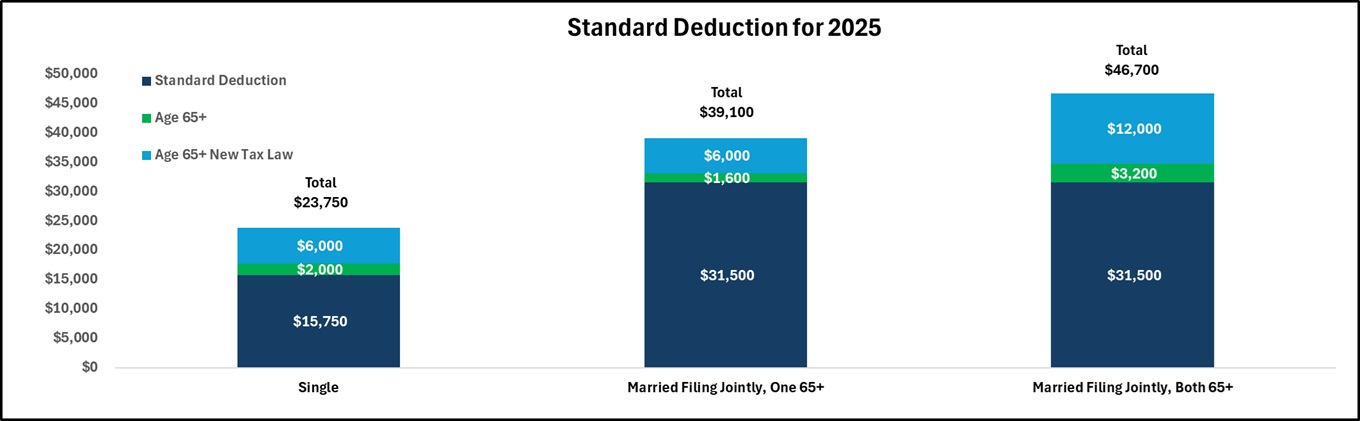
Prior to the new law, taxpayers 65 and older were provided with an aged 65+ deduction in addition to the standard deduction.  The new law retains the first aged 65+ first additional deduction and creates an aged 65+ second additional deduction of $6,000 whether you use the standard deduction or itemize.  The new second additional deduction begins phasing out as your MAGI exceeds $75,000 for single filers and $150,000 for those married filing jointly, and is phased out at $175,000 and $250,000, respectively.  The new aged 65+ second additional deduction applies to 2025-2028.

The 2025 standard deductions are as follows: Standard Deduction plus Aged 65+ First Additional Deduction plus Age 65+ Second Additional Deduction equal Total Standard Deduction: Single $15,750 + $2,000 + $6,000 = $23,750; Married Filing Jointly One 65+ $31,500 + $1,600 + $6,000 = $39,100; Married Filing Jointly Both 65+ $31,500 + $3,200 + $12,000 = $46,700.  See the chart below.

Strategy.  Instead of earning all your income in one year and losing some or all of your deduction, spread out your income to gain more or all of your deduction.

Click to Enlarge
5. Earn More Tip Income

Prior to the new law, tip income did not have its own deduction.  The new law creates a deduction for qualified tip income of up to $25,000 for those filing their taxes as single or married filing jointly.  Tip income is voluntary income from a job where tips are customarily given.  While it is customary to tip a waiter or waitress, it is uncustomary to tip your doctor.  The deduction begins phasing out as your MAGI exceeds $150,000 for single filers and $300,000 for those married filing jointly.  Each $1,000 above $150,000 or $300,000, respectively, reduces your deduction by $100.  The new tip deduction applies to 2025-2028.

Strategy.  Instead of earning all of your tip income in one year and losing some or all of your deduction, spread out your tip income over two years to gain more or all of your deduction.

6. Review Your Estate Plan

Prior to the new tax law, the lifetime gift (in addition to annual gifts) and estate tax exemption was scheduled to collapse by about 50% in 2026.  The new law permanently establishes a lifetime gift (in addition to annual gifts) and estate tax exemption of $15 million for individuals and $30 million for couples (based on portability election) for 2026, with annual inflation adjustments thereafter.

Strategy.  Estate planning includes a host of factors and strategies that go well beyond the estate tax exemption.  Review your gifting strategy of appreciated and unappreciated assets.  Thoroughly understand how nonqualified and qualified assets, including 401(k)s and IRAs, are taxed differently for you versus your surviving spouse versus your children and other beneficiaries.  Your suboptimal estate planning can be a windfall to the IRS and a nightmare to your beneficiaries.

Action Steps

Work closely with your Registered Investment Adviser (RIA) to reduce your taxes and grow and preserve your wealth.

Aaron Skloff, Accredited Investment Fiduciary (AIF), Chartered Financial Analyst (CFA), Master of Business Administration (MBA) is CEO of Skloff Financial Group, a Registered Investment Advisory firm specializing in financial planning, investment management and benefits for small to middle sized companies. He can be contacted at www.skloff.com or 908-464-3060.

Adobe-PDF-Document-icon


Are You Interested in Learning More?

Tags: 401(k), 401(k) Contribution Limits, 401(k) Income Limits, 403(b), 403(b) Contribution Limits, 403(b) Income Limits, 457(b), 457(b) Contribution Limits, 457(b) Income Limits, Estate Planning, Financial Planning, IRA Contribution Limits, Keogh, Required Minimum Distributions, Retirement, retirement plan, Retirement Planning, RMD, Roth 401(k), Roth 403(b), Roth 457(b), Roth IRA, Roth IRA Contribution Limits, Roth IRA Income Limits, SEP IRA, SIMPLE IRA, Social Security, Tax Free, Tax Planning, Taxes, Traditional IRA
https://skloff.com/wp-content/uploads/2016/12/Taxes-This-Way-62476802.jpg 692 1037 Aaron Skloff, AIF, CFA, MBA https://skloff.com/wp-content/uploads/2025/10/sfg-8.png Aaron Skloff, AIF, CFA, MBA2025-10-01 12:00:202026-01-21 15:12:00Top 10 Tax Tips Created by the New Tax Law – Part 2
You might also like
Employee Stock Options – Independent Press
The Good Life List #1 – Review Your Life Insurance
Long Term Care Insurance Pool of Money and Benefit Period – Long Term Care University
Top 6 Most Frequently Asked Questions (FAQs) about the Indiana Partnership for Long Term Care 2014
How the CARES Act Affects Retirement Accounts – Part 3
Maximizing Contributions to Multiple Employer Retirement Plans 2016
How the Age You Retire Changes Your Social Security Benefits on a $50,000 Salary – CNBC
Three Big Reasons You’re Still Broke – Kiplinger’s Personal Finance
Search Search
HTML Button Generator

Categories

  • – ARTICLES CATEGORIES
    • 401(k)
    • College Planning
    • Disability Insurance
    • Estate Planning
    • Financial Planning
    • Investing
    • IRA
    • Life Insurance
    • Long Term Care Insurance
    • Retirement Planning
    • Social Security
    • Taxes
  • – SLIDES CATEGORIES
    • 401(k)
    • College Planning
    • Estate Planning
    • Financial Planning
    • Investing
    • IRA
    • Life Insurance
    • Long Term Care Insurance
    • Retirement Planning
    • Social Security
    • Taxes
  • – VIDEOS CATEGORIES
    • 401(k)
    • College Planning
    • Disability Insurance
    • Estate Planning
    • Financial Planning
    • Investing
    • IRA
    • Life Insurance
    • Long Term Care Insurance
    • Retirement Planning
    • Social Security
    • Taxes

(c) Copyright 2026
Skloff Financial Group
7682 Santa Margherita Way
Naples, FL 34109
908-464-3060

Featured Content

Income Tax and Capital Gains Rates 2026
Retirement Plan Contribution Limits 2026
IRA Contribution and Income Limits 2026
Hybrid Life and Long Term Care Insurance

Information

CRS
Disclosures
Privacy Policy

HTML Button Generator
Link to: FAQs on RMDs: What Retirees Need to Know – Morningstar Link to: FAQs on RMDs: What Retirees Need to Know – Morningstar FAQs on RMDs: What Retirees Need to Know – Morningstar Link to: Health Savings Accounts (HSAs) Explained – 5 Questions – Fidelity Investments Link to: Health Savings Accounts (HSAs) Explained – 5 Questions – Fidelity Investments Health Savings Accounts (HSAs) Explained – 5 Questions – Fidelity I...
Scroll to top Scroll to top Scroll to top