
How to Complete a Backdoor Roth IRA
Skloff Financial Group Question of the Month – May 1, 2026
By Aaron Skloff, AIF, CFA, MBA
Q: Since our income exceeds the eligibility limit for Roth IRA contributions, what other strategies can we use to build my Roth savings?
The Problem — Building Tax-Free Savings
Roth Individual Retirement Accounts (IRAs) are highly desirable for retirement savers because they allow for growth on a tax-free basis, withdrawals on a tax-free basis, and are exempt from required minimum distributions (RMDs). Unfortunately, the IRS imposes income limits on contributions to Roth IRAs. In 2026, the income phase-out limits are from $153,000 to $168,000 for single filers and $242,000 to $252,000 for those married and filing jointly. Translation: if you earn more than $168,000 as a single filer or $252,000 as a joint filer, you cannot contribute to a Roth IRA.
The Solution — Backdoor Roth IRA
A Backdoor Roth IRA is a legal tax strategy that allows high-income earners to build tax-free Roth IRA savings, even when their income exceeds the IRS limits. Instead of contributing directly to a Roth IRA, you make a non-deductible contribution to a Traditional IRA and then convert it to a Roth IRA.
Are You Interested in Learning More?

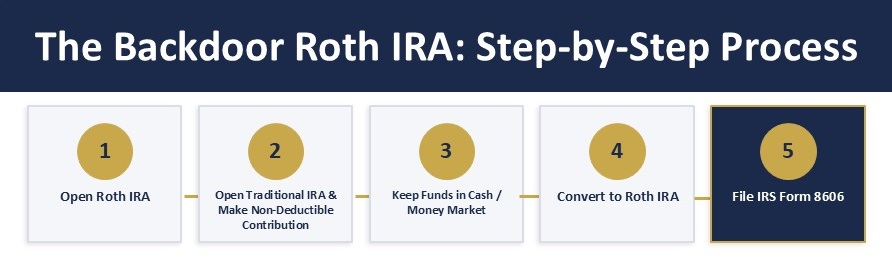
The Backdoor Roth IRA: Step-by-Step Process
Step 1 – Open Roth IRA. If you don’t already have one, open a Roth IRA.
Step 2 – Open Traditional IRA and Make Non-Deductible Contribution. Open a Traditional IRA and contribute up to $7,500 ($8,600 if age 50+) in after-tax dollars. Crucially, do NOT claim a deduction on your federal tax return for this contribution.
Step 3 – Keep Funds in Cash. Leave the contributed funds uninvested or in a stable money market account. Any earnings before conversion could be taxable, so it is best to convert quickly – ideally within a few days.
Step 4 – Covert to a Roth IRA. Convert the full Traditional IRA to a Roth IRA.
Step 5 – File IRS Form 8606. When filing your tax return, include Form 8606 to document that your Traditional IRA contribution was non-deductible (after-tax). This prevents you from being taxed again when you withdraw from the Roth IRA in retirement.
Click to Enlarge
Watch Out for the Pro-Rata Rule. If you have other pre-tax money in any Traditional IRA, SEP-IRA, or SIMPLE IRA, the IRS requires you to calculate taxes on your conversion proportionally – you cannot cherry-pick which dollars are converted. This can create an unexpected tax bill.
How to Avoid Pro-Rata Issues. Rollover existing pre-tax IRA funds into your employer 401(k) or 403(b) before converting. Keep the backdoor IRA separate and ensure a zero balance in all Traditional IRAs at year-end. Complete the conversion in the same year as the contribution.
Key Reminders. Do NOT deduct your Traditional IRA contribution on your tax return. File Form 8606 every year you complete a backdoor conversion. There is no waiting period between contributing and converting. You can do this every year – it resets annually.
Action Step — Complete a Backdoor Roth IRA
Work closely with your Registered Investment Adviser to evaluate your Backdoor Roth IRA conversion opportunities.
Aaron Skloff, Accredited Investment Fiduciary (AIF), Chartered Financial Analyst (CFA), Master of Business Administration (MBA) is CEO of Skloff Financial Group, a Registered Investment Advisory firm specializing in financial planning, investment management and benefits for small to middle sized companies. He can be contacted at www.skloff.com or 908-464-3060.

Have Your 401(k), 403(b), 457(b) Account Professionally Managed
Frequently Asked Questions
Q: Why can’t I contribute directly to a Roth IRA?
The IRS caps direct Roth IRA contributions based on income. In 2026, the phase-out range is $153,000–$168,000 for single filers and $242,000–$252,000 for those married filing jointly — earn above the top of that range and you’re locked out of direct contributions entirely.
Q: What is a Backdoor Roth IRA?
It’s a legal, two-step tax strategy that lets high earners build Roth savings despite exceeding the income limits. Rather than contributing directly to a Roth IRA, you make a non-deductible contribution to a Traditional IRA and then convert those funds to a Roth IRA.
Q: What are the steps to complete a Backdoor Roth IRA?
First, open a Roth IRA if you don’t already have one. Second, open a Traditional IRA and contribute up to $7,500 ($8,600 if you’re 50 or older) in after-tax dollars, making sure not to claim a deduction for it on your tax return. Third, leave the funds in cash or a stable money market account rather than investing them. Fourth, convert the full Traditional IRA balance to your Roth IRA. Fifth, file IRS Form 8606 with your tax return to document that the contribution was non-deductible.
Q: Why should I keep the funds in cash before converting?
Any investment growth that occurs between your contribution and conversion becomes taxable, so it’s best to convert quickly — ideally within a few days — while the funds sit in cash or a stable money market account, minimizing the taxable gain.
Q: What is the Pro-Rata Rule, and why does it matter?
If you hold pre-tax money in any Traditional IRA, SEP-IRA, or SIMPLE IRA, the IRS requires your conversion to be taxed proportionally across all of those balances combined — you can’t choose to convert only the after-tax dollars. This can trigger an unexpected tax bill if you’re not planning around it.
Q: How can I avoid Pro-Rata Rule problems?
Roll any existing pre-tax IRA funds into your employer’s 401(k) or 403(b) plan before converting, so your Traditional IRA balance is effectively zero at year-end. Keep your backdoor IRA separate from other pre-tax accounts and complete the conversion in the same year you make the contribution.
Q: Do I need to file anything special with the IRS?
Yes — file Form 8606 every year you complete a backdoor conversion. This form documents that your Traditional IRA contribution was non-deductible, which prevents the IRS from taxing those dollars a second time when you eventually withdraw from the Roth IRA in retirement.
Q: Is there a waiting period, and can I do this every year?
There’s no required waiting period between the contribution and the conversion. The strategy also resets annually, so you can repeat the full process every year to keep building tax-free Roth savings.