
What Happens if You Die After Using Some of the Benefits in a Hybrid Life and Long Term Care Insurance Policy? – Long Term Care University
Long Term Care University – Question of the Month – 11/15/26
By Aaron Skloff, AIF, CFA, MBA
Q: We read the Long Term Care University article, ‘What Happens if You Die Before Using Any of the Benefits in a Hybrid Life and Long Term Care Insurance Policy?’ and prefer the Hybrid Long Term Care Insurance (LTC) policy. Can you explain what happens if you die after using some of the benefits in a Hybrid Life and Long Term Care (LTC) Insurance policy?
Overview. Hybrid policies provide long term care benefits if you need long term care, a death benefit if you die without needing LTC, or both if you need a limited amount of LTC.
The Problem – Not All Versus Hybrid Life and Long Term Care Insurance Death Benefits Are the Same
Although all Hybrid LTC policies provide a death benefit if you do not need LTC, death benefits vary if you use the policy’s LTC benefits.
Click Here for Your Long Term Care Insurance Quotes

The Solution – Understand Your Policy’s Death Benefits
Hybrid Life and Long Term Care Insurance provides both life and long term care benefits. Each $1 of long term care benefits reduces the death benefit (life insurance benefit) by $1. Some policies provide additional death benefits (DB). Selecting a policy with the right balance of each should be based on your personal needs. The three most common types of death benefits are described below.
Residual Death Benefit. The residual DB is paid even if you use all your LTC benefits.
Minimum Death Benefit. The minimum DB is paid even if you use all your LTC benefits.
No Minimum or Residual Death Benefit. If your use all of your LTC benefits, you will not have a DB.
What Happens if You Die After Using Some of the Benefits in a Hybrid Life and Long Term Care Insurance Policy?
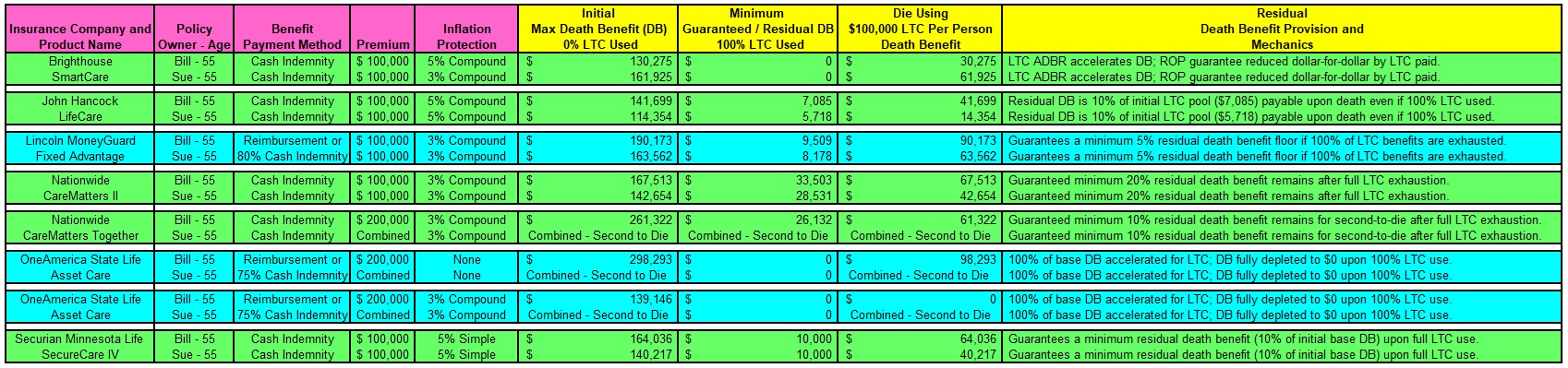
Let’s look at a husband and wife, Bill and Sue, who are each 55 years old and reside in Maryland. They each pay a $100,000 one-time premium ($200,000 combined with Nationwide CareMatters Together and OneAmerica State Life Asset Care) and are expected to need LTC in 25 years at the age of 80. They are comparing Hybrid policies that offer the largest LTC benefits with inflation protection (unless noted). See reimbursement policies in blue and cash indemnity policies in green in the chart below. What happens when they die after they each use $100,000 of LTC benefits? The following chart compares the top policies based on death benefits.
Brighthouse SmartCare. No Minimum or Residual DB policy. If they die after they each use $100,000 of LTC benefits, Bill’s DB is $30,275, while Sue’s DB is $61,925.
John Hancock LifeCare.Residual DB policy. If they die after they each use $100,000 of LTC benefits, Bill’s DB is $41,699, while Sue’s DB is $14,354.
Lincoln MoneyGuard Fixed Advantage.Residual DB policy. If they die after they each use $100,000 of LTC benefits, Bill’s DB is $90,173, while Sue’s DB is $63,562. The policy also includes the Benefit Transfer Rider (BTR). It allows beneficiaries who are also policyholders, the ability to increase their benefits at the first death claim. Beneficiaries have three options: 1. Take the full death benefit. 2. Use the full death benefit to purchase more benefits on their own policy, 3. Take the partial death benefit and use the remainder to purchase more benefits on their own policy.
Nationwide CareMatters II. Minimum DB policy. If they die after they each use $100,000 of LTC benefits, Bill’s DB is $67,513, while Sue’s DB is $42,654.
Nationwide CareMatters Together.Minimum DB policy. If they die after they each use $100,000 of LTC benefits, the second to die DB is $61,322.
OneAmerica State Life Asset Care without Inflation Protection. No Minimum or Residual DB policy. If they die after they each use $100,000 of LTC benefits, the second to die DB is $98,293.
OneAmerica State Life Asset Care with Inflation Protection. No Minimum or Residual DB policy. If they die after they each use $100,000 of LTC benefits, the second to die DB is $0. Their combined use of $200,000 of LTC benefits exceeded the $139,146 DB.
Securian Minnesota Life SecureCare IV.No Minimum or Residual DB policy. If they die after they each use $100,000 of LTC benefits, Bill’s DB is $64,036, while Sue’s DB is $40,217.
Click to Enlarge
Action Step – Compare Death Benefits Before Purchasing Your Policy
Death benefits can differ significantly between each insurance company’s policy. Work closely with an independent insurance expert to compare policies that meet your needs. Since premiums vary greatly based on age, health and marital status, request individualized quotes.
Aaron Skloff, Accredited Investment Fiduciary (AIF), Chartered Financial Analyst (CFA) charter holder, Master of Business Administration (MBA), is the Chief Executive Officer of Skloff Financial Group, a Registered Investment Advisory firm. The firm specializes in financial planning and investment management services for high net worth individuals and benefits for small to middle sized companies. He can be contacted at www.skloff.com or 908-464-3060.

Click Here for Your Long Term Care Insurance Quotes
Frequently Asked Questions
Q: How does using long-term care benefits affect the death benefit in a hybrid policy?
In a hybrid life and long-term care (LTC) insurance policy, long-term care benefits are initially drawn by accelerating the policy’s base life insurance death benefit, typically reducing the death benefit dollar-for-dollar for every $1 of LTC benefits used. If you pass away after using only a portion of your care pool, your beneficiaries will receive whatever remaining life insurance death benefit is left over, paid out income-tax-free. Once the initial death benefit pool is completely depleted through LTC claims, an optional Extension or Continuation of Benefits rider can continue paying for care without further reducing any guaranteed minimum payout.
Q: What is the difference between a Residual Death Benefit, a Minimum Death Benefit, and policies with neither?
Hybrid policies generally fall into three death benefit structures once LTC claims begin: Residual Death Benefit policies, Minimum Death Benefit policies, and policies with neither. Both Residual and Minimum Death Benefit policies guarantee a small, pre-determined payout (often a percentage of the original face amount, such as 5% to 20%, or a flat cap like $10,000) to your beneficiaries even if you exhaust 100% of your long-term care benefits. Conversely, policies with no minimum or residual death benefit—such as Brighthouse SmartCare, OneAmerica Asset Care, and Securian SecureCare IV (depending on design)—reduce the death benefit down to $0 once the accelerated life insurance portion is fully used for care.
Q: How do top carriers compare in the death benefits they leave behind after partial or full LTC claims?
Top insurance carriers structure their post-claim death benefits differently to balance maximum care pools against legacy protection. For example, Nationwide CareMatters II is well known for offering one of the highest guaranteed minimum death benefits in the industry at 20% of the specified face amount, while Lincoln MoneyGuard Fixed Advantage and John Hancock LifeCare provide smaller residual death benefits (such as the lesser of 5% or $10,000) even after all LTC benefits are exhausted. By contrast, carriers like OneAmerica State Life Asset Care and Brighthouse SmartCare prioritize maximizing total LTC leverage and lifetime care riders rather than guaranteeing a residual payout if all benefits are spent.
Q: How do joint or second-to-die hybrid policies handle death benefits if one spouse uses LTC benefits?
In joint hybrid policies designed for couples—such as Nationwide CareMatters Together or OneAmerica State Life Asset Care—the death benefit is typically structured on a second-to-die basis, meaning it is paid out only after both spouses have passed away. If the first spouse requires long-term care, their claims draw down from the shared pool of accelerated death benefits, reducing the eventual payout left for the surviving spouse’s heirs. However, if the policy includes a Lifetime Continuation of Benefits rider, the surviving spouse remains fully protected for their own future care needs even if the first spouse’s care completely exhausted the base death benefit.
Q: What is a Benefit Transfer Rider, and how does it help surviving spouses?
Available on policies like Lincoln MoneyGuard Fixed Advantage, a Benefit Transfer Rider (BTR) gives a surviving spouse added flexibility when the first insured spouse passes away without having exhausted their policy. Rather than simply taking the remaining cash death benefit, the surviving spouse—if they also own an eligible policy—can choose to apply all or part of that death benefit directly into their own policy to purchase additional long-term care and death benefits without undergoing new medical underwriting.
Q: Are remaining death benefits and long-term care payouts taxed if you die after using some benefits?
Under Internal Revenue Code (IRC) Section 7702B and Section 101(a), both qualified long-term care payouts and any remaining life insurance death benefit paid to your heirs are generally received completely free of federal income taxes. Even if a hybrid policy is funded with a single lump-sum premium and classified as a Modified Endowment Contract (MEC), the tax-free status of both the LTC benefits and the remaining death benefit remains fully intact, though taking personal loans or early cash surrenders during your lifetime could trigger taxes on gains.