

Hybrid Life and Long Term Care Insurance with 10-Pay Premiums – Long Term Care University

Long Term Care University – Question of the Month – 05/15/26
By Aaron Skloff, AIF, CFA, MBA
Q: We read the Long Term Care University article ‘Traditional Versus Hybrid Life and Long Term Care Insurance’ and prefer the Hybrid Life and Long Term Care Insurance (LTC) policy. Can we pay for Hybrid Life and LTC policies over 10 years? Will the premium be guaranteed each year?
The Problem – Guaranteed Premiums for an Insurance Policy Paid Over Time
Can you imagine if your major medical health insurance, car insurance or homeowners insurance premiums were guaranteed from year to year? Not only are those premiums not guaranteed, but the insurance companies can increase deductibles or even drop your coverage. In the case of major medical health insurance, the insurance company can simply remove your doctors from their “preferred provider network” or “in plan providers”. This leaves you with a list of inferior doctors to choose from or forces you to pay additional out of pocket costs by going out of your network (if your plan even allows out of network providers). Many believe these same problems exist in Hybrid Life and LTC policies.
Click Here for Your Long Term Care Insurance Quotes

The Solution – Hybrid Life and Long Term Care Insurance Premiums Paid Over 10 Years with Guaranteed Premiums Each Year
Many believe Hybrid Life and LTC Insurance companies can simply eliminate which care providers you choose, change your deductible, reduce or drop your coverage, or increase your premiums. Fortunately, Hybrid Life and LTC Insurance policies are based on a pool of money that allows you to choose your care providers without a list determined by the insurance company. The policies have guaranteed deductibles and guaranteed coverage amounts. You cannot be dropped if you pay your premium – even if you file multiple claims. The policies have guaranteed premiums.
Numbers Speak Louder than Words. Let’s look at a husband and wife, Bill and Sue, who are each 55 years old and reside in Maryland. They each pay a $10,000 premium per year for 10 years ($20,000 combined with Nationwide CareMatters Together and OneAmerica State Life Asset Care) and are expected to need LTC in 25 years at the age of 80. Insurance companies classify a premium paid-up (no further payments required) in 10 years as a “10-Pay”. Bill and Sue are comparing Hybrid policies that offer the largest LTC benefits and inflation protection (unless noted otherwise) and prefer cash indemnity. See reimbursement policies in blue and cash indemnity in green in the chart below.
How the Insurance Policies Compare to One Another. The following table reflects Sue and Bill’s monthly and total benefits at age 80. Brighthouse SmartCare provides $12,863 monthly and $998,452 total benefits for Bill, and $11,057 monthly and $858,278 total benefits for Sue – the highest total benefits with full cash indemnity and without unlimited benefits. John Hancock LifeCare provides $2,510 monthly and $180,708 total benefits for Bill, and $1,995 monthly and $143,646 total benefits for Sue. Lincoln MoneyGuard Fixed Advantage provides $13,255 monthly and $1,028,832 total benefits for Bill, and $11,400 monthly and $884,872 total benefits for Sue – the highest total benefits without full cash indemnity and without unlimited benefits, and a 0 day elimination period. Nationwide Care Matters II provides $12,401 monthly and $962,539 total benefits for Bill, and $10,638 monthly and $825,737 total benefits for Sue. Nationwide CareMatters Together provides $12,721 monthly benefits for Bill and Sue and $1,357,437 (shared). OneAmerica State Life Asset Care without inflation protection provides $8,796 monthly benefits for Bill and Sue and unlimited, lifetime total benefits – the highest total benefits without inflation protection (unlimited). OneAmerica State Life Asset Care with 3% compound inflation protection provides $8,891 monthly benefits for Bill and Sue and unlimited, lifetime total benefits – the highest total benefits with inflation protection (unlimited). Securian Minnesota Life SecureCare IV provides $11,298 monthly and $858,648 total benefits for Bill, and $9,904 monthly and $752,685 total benefits for Sue.
Click to Enlarge
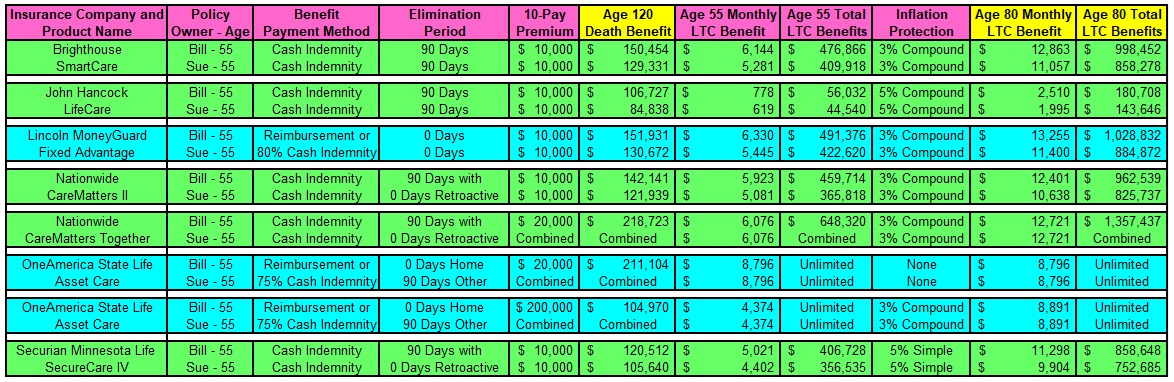
Conclusions. Premium payments options vary by insurance companies. While a single pay Hybrid Life and LTC Insurance policy may provide the most generous benefits, the same policy may provide less generous benefits if the premiums are paid over time – such as 10 years with guaranteed premiums each year. Since premiums vary greatly based on age, health and marital status, request individualized quotes.
Aaron Skloff, Accredited Investment Fiduciary (AIF), Chartered Financial Analyst (CFA) charter holder, Master of Business Administration (MBA), is the Chief Executive Officer of Skloff Financial Group, a Registered Investment Advisory firm. The firm specializes in financial planning and investment management services for high net worth individuals and benefits for small to middle sized companies. He can be contacted at www.skloff.com or 908-464-3060.

Click Here for Your Long Term Care Insurance Quotes
Frequently Asked Questions
Q: What is a 10-pay premium structure for hybrid life and long-term care insurance?
A 10-pay structure is an asset-based insurance payment model where the policyholder completely funds their hybrid life and long-term care (LTC) policy over exactly 10 consecutive years. After this 10-year period concludes, the policy is officially classified as “paid-up,” meaning no further financial contributions are ever required to keep the coverage active. This method splits the cost over a decade, functioning as an accessible alternative to funding the entire policy upfront with a massive single-premium payment.
Q: Are the premium rates guaranteed to remain the same throughout the 10 years?
Yes, hybrid life and long-term care insurance policies feature guaranteed premiums, meaning the annual payment amount is locked in and will never increase during the 10-year funding window. This completely eliminates the volatility seen in traditional long-term care, health, or auto insurance, where carriers frequently spike rates or reduce policyholder benefits over time. Providing complete predictable pricing protects your retirement assets from unforeseen premium hikes while you are paying into the plan.
Q: What happens to the insurance policy if I never actually need long-term care?
If you never require long-term care, your hybrid policy pivots to its secondary function and pays a tax-free death benefit to your designated beneficiaries. Unlike traditional “use-it-or-lose-it” long-term care policies where decades of premiums vanish if you stay healthy, a hybrid asset-based policy guarantees a payout. This ensures that your paid-in premium dollars are never wasted, acting either as a critical safety net for health services or as a wealth-transfer vehicle for your heirs.
Q: Can the insurance company dictate which doctors or long-term care providers I am allowed to use?
No, hybrid insurance policies are structured around a set pool of money, granting you complete autonomy to select your own care facilities and medical providers. Traditional medical insurance plans restrict patients to a “preferred provider network,” but hybrid LTC policies do not utilize restrictive doctor lists. Furthermore, if you choose a cash indemnity policy, you receive your monthly benefits directly in cash, giving you total freedom to pay for home care, family caregivers, or assisted living without submitting receipt restrictions.
Q: How do benefits differ between a single-premium hybrid policy and a 10-pay policy?
While a 10-pay policy offers better short-term liquidity by stretching out costs, it generally generates slightly less generous benefits overall compared to a single-premium policy funded with the exact same total amount. When you pay a lump sum upfront, the insurance carrier can immediately invest the entirety of your premium, which allows them to leverage greater compounding and offer higher monthly and total benefit pools. Delaying the payments over ten years reduces the interest-earning timeframe for the insurer, resulting in a modest reduction of the ultimate long-term care payout.
Q: Are the long-term care benefits received from a hybrid policy subject to income tax?
Generally, the monthly payouts received from a qualified hybrid life and long-term care insurance policy are tax-free under federal law. As long as your medical professional certifies that you cannot perform at least two activities of daily living (ADLs) or are suffering from severe cognitive impairment, the funds are treated as excludable health benefits. This crucial tax advantage prevents your care funds from being eroded by income brackets, ensuring every dollar of your monthly maximum goes directly toward offsetting medical bills.
If you are evaluating specific plans, let me know your current age, marital status, and whether you prefer unlimited lifetime benefits so I can help narrow down your options.