OneAmerica State Life Asset Care Hybrid Life and Long Term Care Insurance Review – Long Term Care University
Long Term Care University – Question of the Month – 04/15/26
By Aaron Skloff, AIF, CFA, MBA
Q: We read the Long Term Care University article ‘Traditional Versus Hybrid Life and Long Term Care Insurance’ and prefer the Hybrid Long Term Care Insurance (LTC) policy. Can you please review the OneAmerica State Life Asset Care Hybrid LTC policy?
Overview. State Life Insurance Company Group is part of OneAmerica, an A.M. Best A+ rated, founded in 1877. The OneAmerica State Life Asset Care policy is a Hybrid Life and Long Term Care Insurance (also called Combination or asset based) policy. With Traditional LTC policies, premiums can be increased and you may not receive any benefits if you do not need LTC. With Hybrid LTC policies the benefits and premiums are guaranteed. The insurance company either: 1) pays you if you need LTC, 2) pays your heirs if you do not need LTC, 3) pays you and your heirs if you need a modest amount of LTC or 4) pays you a refund if you cancel the policy.
Click Here for Your Long Term Care Insurance Quotes

OneAmerica State Life Asset Care is Unique Because It Provides Lifetime Benefits. One of the largest long term care insurance companies reported that 50% of all claims dollars it has paid are due to dementia, including Alzheimer’s disease. According to the Alzheimer’s Association, 1 in 9 people ages 65 and older and about 1 in 3 people ages 85 and older have Alzheimer’s disease. The duration of Alzheimer’s disease is generally four to eight years after a diagnosis, but can last as long as 20 years.
Most insurance mitigate their own risks and increase consumers’ risks by limiting coverage to a maximum of six or seven years of care. State Life Asset Care offers lifetime benefits with an unlimited number of years of care and an unlimited dollar amount of total LTC benefits. If a couple each needed 10 years of care, State Life Asset -Care lifetime benefits could pay a couple almost $1 million more LTC benefits than a policy that would only pay for six years of care.
OneAmerica State Life Asset Care Policy Options. The policy options include: Benefit periods of 25 months to lifetime (unlimited number of years); Inflation protection of none, 2%, 3% and 5% compound; Elimination period of zero days for home care and 90 days for other care; Reimbursement based benefit payment method; Return of premium; Second to die death benefit; Cash benefits up to 75% of the maximum monthly benefit for home care (no receipts required) up to the death benefit limit (Acceleration of Benefits).
OneAmerica State Life Asset Care Policy Premium Payment Options. They include: one time (single-pay), 5 years (5-pay), 10 years (10-pay), 20 years (20-pay) and pay to age 95, based on age. Like buying a home, the longer your payment option, the higher your cumulative payments.
OneAmerica State Life Asset Care Tax Benefits. In addition to the LTC and death benefits being paid on a tax free basis, the LTC portion of the premium is eligible for a tax deduction by individuals or can be expensed by businesses (including sole proprietorships). Individuals can pay premiums from their HSA.
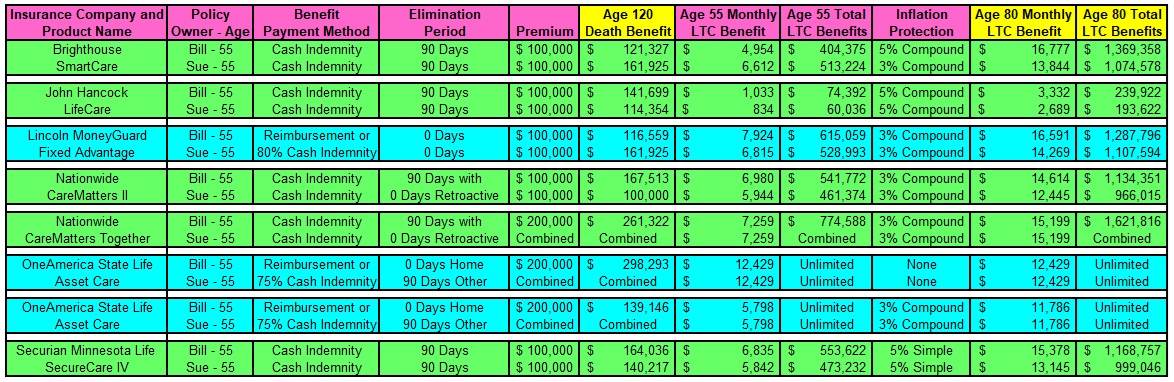
How OneAmerica State Life Asset Care Compares with Other Hybrid Life and LTC Policies. Let’s look at a husband and wife, Bill and Sue, who are each 55 years old and reside in Maryland. They each pay a $100,000 one-time premium ($200,000 combined with Nationwide and OneAmerica State Life) and are expected to need LTC in 25 years at the age of 80. They are comparing Hybrid policies that offer the largest LTC benefits and inflation protection (unless noted otherwise) and prefer lifetime benefits and an unlimited dollar amount of total LTC benefits. See reimbursement policies in blue and cash indemnity policies in green in the chart below.
OneAmerica State Life Asset Care Outperforms Competitors with Lifetime Benefits and an Unlimited Dollar Amount of Total LTC Benefits.
Bill and Sue will each have $12,429 monthly or $11,786 monthly with 3% compound inflation protection, and unlimited total LTC benefits. Brighthouse SmartCare is a strong cash indemnity alternative for Bill and Sue due to its high monthly and total LTC benefits, and its option to link policy values to major market indices. John Hancock LifeCare is notable for its option to link policy values to major market indices. Lincoln MoneyGuard Fixed Advantage is a strong (partial cash indemnity) alternative Bill and Sue due to its high monthly LTC benefits to its 0 day elimination period. Nationwide Care Matters II is a strong cash indemnity alternative for Bill and Sue due to its high monthly and total LTC benefits and its 90 day with zero day retroactive elimination period. Nationwide CareMatters Together is a strong cash indemnity alternative for Bill and Sue due to its high monthly LTC benefits and its 90 day with zero day retroactive elimination period. Securian Minnesota Life SecureCare IV is a strong cash indemnity alternative for Bill and Sue due to its higher monthly and total LTC benefits and its 90 day with zero day retroactive elimination period.
Click to Enlarge
Conclusions. OneAmerica State Life Asset Care provides lifetime benefits and an unlimited dollar amount of total benefits. Since premiums vary greatly based on age, health and marital status, request individualized quotes.
Aaron Skloff, Accredited Investment Fiduciary (AIF), Chartered Financial Analyst (CFA) charter holder, Master of Business Administration (MBA), is the Chief Executive Officer of Skloff Financial Group, a Registered Investment Advisory firm. The firm specializes in financial planning and investment management services for high net worth individuals and benefits for small to middle sized companies. He can be contacted at www.skloff.com or 908-464-3060.

Click Here for Your Long Term Care Insurance Quotes
Frequently Asked Questions
Q: What is the OneAmerica State Life Asset Care policy?
A: Asset Care is a hybrid (also called combination or asset-based) life and long-term care insurance policy issued by The State Life Insurance Company, part of OneAmerica, an A.M. Best A+ rated carrier founded in 1877. Rather than paying premiums into a stand-alone long-term care policy that could lapse in value if care is never needed, a policyholder funds a single life insurance contract that guarantees one of several outcomes: benefits are paid to the insured if long-term care is needed, a death benefit goes to heirs if it is not, a combination of both is paid if only modest care is used, or premiums are refunded if the policy is surrendered.
Q: How is a hybrid policy like Asset Care different from a traditional long-term care policy?
A: Traditional long-term care insurance is priced on assumptions that can change over time, so insurers may raise premiums in later years, and a policyholder who never files a claim receives nothing back for the premiums paid. Hybrid designs such as Asset Care lock in both the premium and the benefit amount at issue, and because the coverage is built on a life insurance chassis, unused long-term care benefits convert into a death benefit for beneficiaries instead of disappearing.
Q: What makes Asset Care stand out from other hybrid policies?
A: Asset Care’s signature feature is a true lifetime benefit option, meaning both the number of years of covered care and the total dollar amount of benefits can be unlimited, whereas most competing hybrid products cap total benefits at a defined pool of money, often calculated for around six or seven years of care. This matters because a large share of long-term care claims are driven by dementia, including Alzheimer’s disease, a condition that can require care for well beyond a typical benefit cap, sometimes lasting upwards of twenty years, so a couple who both need a decade or more of extended care could receive substantially more in lifetime total benefits under an unlimited design than under a capped one.
Q: How does Asset Care compare financially to competing hybrid policies?
A: In an illustrative example, a 55-year-old husband and wife each fund the policy with a $100,000 single premium and are projected to need care at age 80, twenty-five years later. Under this scenario, Asset Care has been shown to provide each spouse with a monthly benefit in the range of roughly $11,800 to $12,400 depending on whether inflation protection is added, paired with unlimited lifetime total benefits, a combination that distinguishes it from competitors that may offer a higher monthly figure but cap the total dollars available over the life of the claim.
Q: What policy design options are available with Asset Care?
A: Buyers can select a benefit period ranging from as short as 25 months up to an unlimited lifetime benefit, choose inflation protection of none, 2%, 3%, or 5% compound growth, and pick an elimination (waiting) period of zero days for home care versus 90 days for facility or other types of care. The base design pays benefits on a reimbursement basis, meaning receipts are submitted for eligible expenses, though a cash acceleration-of-benefits feature allows up to 75% of the maximum monthly benefit for home care to be paid without receipts. Additional features include a return-of-premium option and a second-to-die death benefit for couples.
Q: What premium payment schedules does Asset Care offer?
A: Premiums can be funded as a single lump sum, or spread over 5, 10, or 20 years, or paid on a schedule that runs until age 95, with the specific options available depending on the applicant’s age. As with financing a home, choosing a longer payment schedule generally means paying more in total premium dollars over time, even though each individual payment is smaller.
Q: Are there tax advantages to funding an Asset Care policy?
A: Both the long-term care and death benefit portions of the policy are generally paid out income-tax-free. In addition, the long-term care component of the premium can qualify for a personal income tax deduction, or be deducted as a business expense, including for sole proprietors, and premiums may also be paid using funds from a Health Savings Account.