

How International Benefits Compare Among The Top Hybrid Life and Long Term Care Insurance Policies – Long Term Care University
Long Term Care University – Question of the Month – 09/15/26
By Aaron Skloff, AIF, CFA, MBA
Q: We read the Long Term Care University article, ‘Not All International Benefits Are the Same on Hybrid Life and Long Term Care Insurance Policies’. Can you compare how international benefits compare among the top Hybrid Life and Long Term Care (LTC) Insurance policies?
The Problem – Not All International Benefits Are the Same
Some insurance companies limit your cash benefits while abroad, while others only allow you to use a portion of your total benefits, and limit the type of care you can receive.
Click Here for Your Long Term Care Insurance Quotes

The Solution – Understand Your Policy’s International Benefits
Understanding the key limitations and restrictions on your policy’s international benefits will help you make a more educated decision on which policy to purchase. Policies with 100% monthly benefits abroad, full length (duration) of benefits and home care provide the greatest flexibility.
How Policies Compare
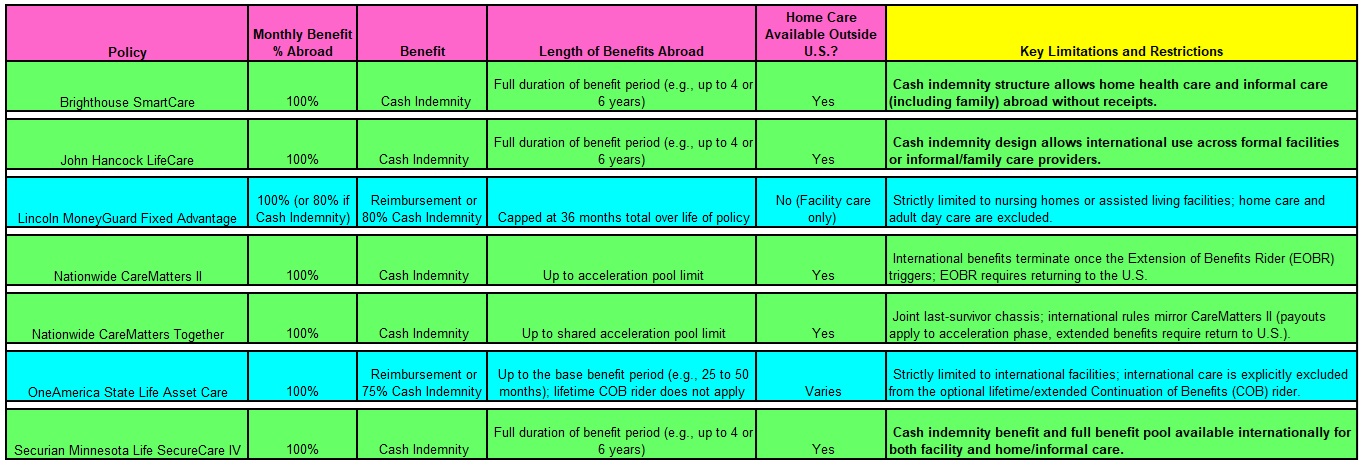
The following chart compares the top policies based on international benefits. Companies highlighted in green provide 100% cash indemnity benefits, while those in blue do not. Companies with bolded Key Limitations and Restrictions offer the greatest flexibility.
Brighthouse SmartCare. With 100% use of monthly benefit, full duration of benefits and home care (including family), it is a top choice.
John Hancock LifeCare. With 100% use of monthly benefit, full duration of benefits and home care (including family), it is a top choice.
Lincoln MoneyGuard Fixed Advantage. With only 80% use of monthly benefit as cash indemnity, only 36 months of international benefits and care limited to nursing homes or assisted living facilities (no home care), it is not a top choice.
Nationwide CareMatters II. Despite 100% monthly benefit, and home care, the duration of benefits is limited to the acceleration pool (e.g.: 2 years). Thus, it is not a top choice.
Nationwide CareMatters Together. Despite 100% monthly benefit, and home care, the duration of joint benefits is limited to the acceleration pool (e.g.: 2 years). Thus, it is not a top choice.
OneAmerica State Life Asset Care. With only 75% use of monthly benefit as cash indemnity, the duration of joint benefits is limited to the base benefit (e.g.: 25 months) and care limited to facilities (no home care), it is not a top choice.
Securian Minnesota Life SecureCare IV. With 100% use of monthly benefit, full duration of benefits and home care (including family), it is a top choice.
Click to Enlarge
Action Step – Compare International Benefits Before Purchasing Your Policy
International benefits can differ significantly between each insurance company’s policy. Work closely with an independent insurance expert to compare policies that meet your needs. Since premiums vary greatly based on age, health and marital status, request individualized quotes.
Aaron Skloff, Accredited Investment Fiduciary (AIF), Chartered Financial Analyst (CFA) charter holder, Master of Business Administration (MBA), is the Chief Executive Officer of Skloff Financial Group, a Registered Investment Advisory firm. The firm specializes in financial planning and investment management services for high net worth individuals and benefits for small to middle sized companies. He can be contacted at www.skloff.com or 908-464-3060.

Click Here for Your Long Term Care Insurance Quotes
Frequently Asked Questions
Q: Why do international long-term care benefits vary so widely among hybrid policy providers?
Insurance companies manage risk differently when policyholders receive care outside the United States due to varying international healthcare standards, regulatory oversight, and potential currency or verification challenges. While some carriers offer comprehensive global coverage that mirrors their domestic benefits, others restrict international benefits by limiting care strictly to formal nursing facilities, placing time caps on overseas claims (such as 36 or 48 months), or capping the maximum monthly payout. Consequently, policyholders planning to retire or travel abroad must carefully evaluate specific policy definitions rather than assuming global care is fully covered.
Q: What is the key difference between cash indemnity benefits and reimbursement models when receiving care abroad?
Cash indemnity benefits pay a fixed monthly cash amount directly to the policyholder upon qualifying for long-term care, without requiring receipts, itemized bills, or proof of formal care provider licensing. In contrast, reimbursement models require policyholders to submit proof of qualified expenses from approved, licensed care facilities or certified home health agencies before receiving reimbursement. For international care, indemnity policies offer far greater flexibility, allowing policyholders to pay informal care providers, family members, or local caregivers in countries where formal long-term care infrastructure or licensing may not exist.
Q: How does Securian SecureCare IV handle international benefits compared to other hybrid policies?
Securian SecureCare IV is notable in the market for providing 100% of its maximum monthly cash indemnity benefit even when care is received outside the United States. Because it operates as a cash indemnity policy, policyholders can use their full monthly benefit payment internationally without restrictions on care setting or local licensure requirements. This feature makes it particularly attractive for individuals planning long-term international residence or extended stays abroad during retirement.
Q: How do carriers like OneAmerica, Lincoln Financial, and Nationwide approach international long-term care coverage?
Different insurance carriers implement distinct limitations on international benefits depending on their policy structures and optional riders. For instance, while some policies offer international coverage for a primary benefit period, optional Continuation of Benefits riders (such as those offered by OneAmerica) may not extend lifetime coverage abroad. Other carriers, like Lincoln Financial or Nationwide, may limit international payouts to formal facility care (such as nursing homes) or enforce a maximum benefit pool cap (such as 36 months of benefits) while outside the United States, after which the policyholder must return domestically to continue drawing benefits.
Q: What medical qualification criteria must be met to trigger long-term care benefits while residing abroad?
To trigger benefits under a tax-qualified hybrid policy, a US-licensed healthcare practitioner must certify that the insured is chronically ill, meaning they are unable to perform at least 2 out of 6 Activities of Daily Living (ADLs)—such as bathing, dressing, eating, transferring, toileting, or continence—for at least 90 days, or require substantial supervision due to severe cognitive impairment. When living abroad, insurance companies typically require documentation from a U.S.-equivalent licensed physician or may require initial or ongoing assessments to be reviewed by a U.S. medical practitioner to confirm benefit eligibility.
Q: How does currency exchange and international inflation impact overseas long-term care claims?
Hybrid life and LTC insurance policies issue benefit payments in U.S. Dollars (USD), meaning policyholders residing abroad are exposed to exchange rate fluctuations when converting funds into local currencies to pay for care. While an optional inflation protection rider increases the policy’s USD monthly benefit over time, rapid inflation in foreign healthcare costs or currency devaluation can alter the purchasing power of those benefits overseas. Policyholders receiving cash indemnity benefits can convert funds as needed, but reimbursement policies will cap payouts at the lesser of actual qualifying USD-equivalent expenses or the policy’s maximum monthly limit.